
How employee advocacy helps marketing extend reach without more paid spend
.png)


There’s a tension at the heart of most marketing teams right now.
On one side, the expectation to grow. More reach, more pipeline, more impact. On the other, the reality that the usual levers are getting more expensive and less effective.
Paid media costs keep climbing. Organic reach keeps shrinking. And even when you do everything “right,” results don’t always follow in the way they used to.
So ,the question becomes less about how to do more, and more about how to get more from what you already have.
This is exactly where employee advocacy starts to matter. Not as a trend, not as a side project, but as a practical way to extend your reach without increasing spend.
The real reason reach is getting harder
It’s easy to blame algorithms. And to be fair, they are part of the problem.
Social platforms increasingly prioritize content from individuals over brands. That means your company page, no matter how carefully managed, is competing at a disadvantage in the feed.
At the same time, audience behavior has shifted.
People are more sceptical of brand messaging and more selective about what they engage with. Trust has moved away from institutions and toward individuals.
The data backs that up:
- 92% of people trust recommendations from individuals over brands
- 88% of consumers trust recommendations from people they know above all other forms of advertising
In other words, it’s not just that your content is struggling to get seen. When it is seen, the source often works against you.
Why employee advocacy changes the dynamic
Employee advocacy flips that equation.
Instead of relying on a central brand voice, you’re distributing content through the people behind the brand – and that changes both reach and response.
The impact is hard to ignore:
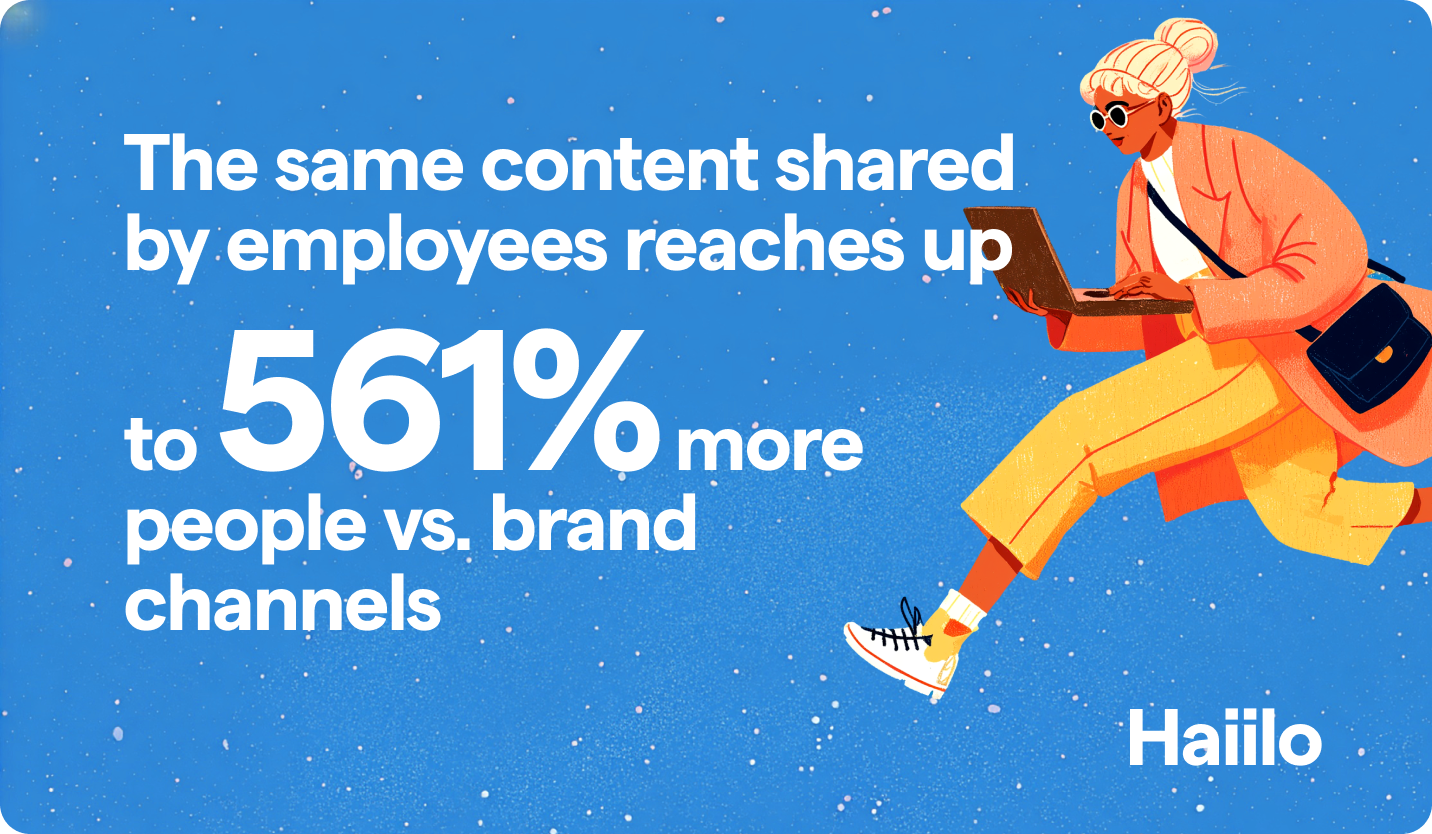
- Content shared by employees reaches up to 561% more people than the same content shared by brand channels
- Employee-shared posts generate significantly higher engagement, often around 8x more than brand content
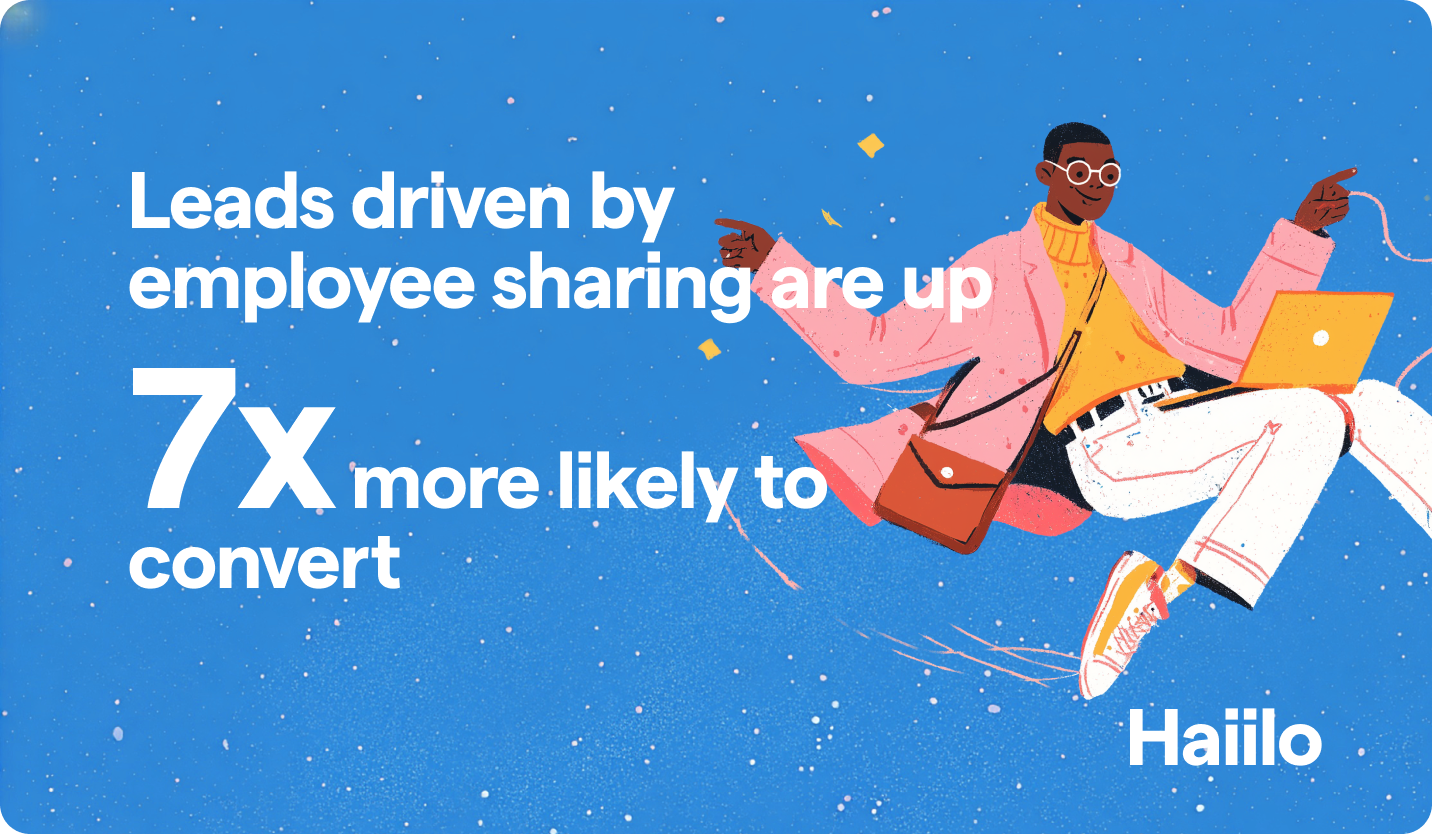
- Leads driven by employee sharing are up to 7 times more likely to convert
That’s not (just) a marginal improvement, it’s a fundamentally different distribution model. And it works because of something quite simple: people engage with people.
💡Read: How marketing can retain credibility in a skeptical world
It’s not just more reach. It’s better reach.
One of the biggest misconceptions about employee advocacy is that it’s purely a volume play. More accounts, more impressions, more visibility.
But the real value sits in the quality of that reach.
When someone sees a post from a brand, they understand the agenda. It’s marketing. That doesn’t mean it’s ignored, but it does change how it’s interpreted.
When someone sees a post from an employee, it lands differently. It feels closer to a recommendation than a campaign.
That difference shows up in performance:
- 73% of marketers say employee advocacy increases engagement, with many reporting it doubles or triples performance
- Employee-generated content consistently delivers stronger interaction and higher relevance compared to brand posts
It’s the same message, but in a different context. And that context is what drives action.
The distribution problem most teams don’t talk about
If you step back, most marketing teams aren’t short on content.
They’re producing blog posts, reports, campaigns, videos, thought leadership, all the time.
The real issue is what happens after that content goes live.
A typical cycle looks something like this:
- Publish the content
- Share it a few times on brand channels
- Maybe support it with paid
- Then move on to the next thing
The lifespan is short, and the reach is limited.
Employee advocacy changes that pattern – or at least adds another stage.
Instead of a single broadcast, content becomes something that can be shared, reshaped, and extended across multiple networks and moments.
The same asset suddenly has more staying power. Not because you’re forcing repetition, but because it’s being shared by different people, in different ways, to different audiences.
Why this matters when budgets are under pressure
When marketing budgets tighten, the focus sharpens fast.
You start looking closely at what’s driving actual results versus what’s just consuming spend.
Employee advocacy stands out in that context because it shifts the balance between paid, owned, and earned channels.
It doesn’t eliminate the need for paid media, but it reduces your reliance on it. And importantly, it improves efficiency:
- Advocacy programs can generate up to 4x more leads than other approaches
- They’re also associated with lower acquisition costs and stronger conversion performance
That combination matters. Especially when you’re being asked to do more with less.
💡Read: How Otis built a global employee advocacy culture
Why most advocacy programs struggle to get traction
For something that works so well in theory, employee advocacy often falls flat in practice.
Usually, it comes down to friction.
Employees don’t share because:
- They’re unsure what’s appropriate
- The content isn’t easy to access or use
- Writing posts takes time they don’t have
- There’s no clear feedback loop on whether it makes a difference
So even when people are willing, participation stays inconsistent. Without that scale or consistency, the impact never quite materializes.
What makes advocacy actually work
The most successful programs all solve the same set of problems. They make participation feel easy, relevant, and worthwhile.
That tends to show up in a few key ways:
- Simple sharing: If it takes effort, it won’t happen regularly
- Relevant content: People share what reflects their role and interests
- Clear guardrails: Enough structure to stay on-brand, without scripting everything
- Visible impact: People can see the reach, clicks, or engagement they generate
When those pieces are in place, advocacy becomes less of a campaign and more of a habit. And that’s where the real value builds over time.
💡Read: How Eilakaisla turned employee voices into a competitive advantage
The compounding effect most brands underestimate
One of the underrated aspects of employee advocacy is how it compounds.
As employees continue to share:
- Their networks grow
- Their credibility increases
- Their content performs better
That creates a distributed layer of influence that sits alongside your brand channels. Over time, that layer becomes incredibly powerful.
It’s not just that your content travels further. It travels through trusted pathways, repeatedly, to audiences that are more likely to engage.
That’s difficult to replicate through paid media alone.
A quick reality check
There’s often one objection that comes up early: “Employees won’t share.” In some cases, that’s true. But more often, it’s only half the problem.
Most employees are open to sharing. What they’re not open to is extra work, unclear expectations, or content that doesn’t feel relevant to them. When those barriers are removed, participation looks very different.
💡Read: How LG turned advocacy into a growth engine
Once a program gains momentum, it tends to sustain itself. Because employees start to see the personal benefit too, whether that’s visibility, credibility, or professional growth.
So what does this mean for marketing?
If you zoom out, the shift is fairly clear. Marketing is becoming more distributed, more human, and more reliant on trust.
Employee advocacy fits naturally into that shift because it:
- Extends the reach of content you’re already creating
- Delivers stronger engagement and conversion outcomes
- Reduces dependence on paid amplification
- Builds a more credible, human brand presence
All without adding more pressure on content production or budget.
Final thought (and where Haiilo comes in)
Of course, none of this works if it’s difficult to execute. The difference between a good idea and a working channel is usually simplicity.
Making it easy for people to share. Keeping everything on-brand without slowing things down. And connecting activity to results in a way marketing can actually report on.
That’s where platforms like Haiilo Advocacy come into play. Not by changing the idea of employee advocacy, but by making it practical to run at scale.
If you’re looking to extend your reach without increasing paid spend, it’s worth exploring what that looks like in a structured, measurable way.
Because chances are, the audience you want to reach is already closer than you think.
Employee advocacy reach FAQs
Employee advocacy is when employees share company content, insights, and updates with their own professional networks, typically on social media. Rather than relying solely on brand channels, organizations can amplify content through the people behind the brand. This helps marketing teams reach wider audiences in a way that often feels more authentic and trustworthy than traditional brand-led communication.
Social platforms increasingly favour content shared by individuals over content published by company pages. When employees share content, it is exposed to their networks, helping brands reach audiences that might never interact with a corporate account. Research consistently shows that employee-shared content can generate significantly more reach and engagement than the same content shared through brand channels alone.
Yes. Employee advocacy gives marketing teams an additional distribution channel that does not require ongoing advertising spend. While it is not a replacement for paid media, it can help organizations generate more visibility, engagement, and leads from content they already create. This can improve marketing efficiency and reduce the pressure to increase paid budgets.
Most advocacy programs fail because participation feels difficult or time-consuming. Employees may be unsure what to share, lack access to relevant content, or feel they do not have time to create posts. Successful programmes remove these barriers with simple sharing tools, clear guidelines, personalized content recommendations, and visibility into results.
The most effective programs make advocacy easy, relevant, and rewarding. Employees need access to content that reflects their interests and expertise, along with clear guardrails that help them share confidently. When organizations also provide insights into reach, engagement, and impact, advocacy becomes an ongoing habit rather than a one-off campaign, delivering long-term value for both marketing teams and employees.
Find
your
flow
Bring communication, knowledge, and tools into one calm place — and help your people find their flow.