
How AI is changing employee advocacy (and why a human touch matters more than ever)



AI is making employee advocacy easier to scale, but the real opportunity isn't automation. It's helping more employees share their expertise, stories, and perspectives in ways people actually trust.
For years, employee advocacy has been built around a simple idea: people trust people more than brands.
That idea hasn't changed.
What has changed is the amount of content everyone is expected to create, share, and engage with. Employees are juggling packed calendars, overflowing inboxes, multiple comms channels, and increasingly high expectations around personal branding. At the same time, organizations are trying to reach audiences who trust traditional corporate messaging less than they used to.
Enter advocacy AI.
AI is quickly becoming one of the biggest shifts employee advocacy has seen in years. Not because it's replacing advocates. Not because it's writing perfect social posts. And not because it's turning every employee into a content creator overnight.
The real story is more interesting.
Advocacy AI is lowering barriers to participation, helping employees share content more confidently, and making advocacy programs easier to scale. But it's also raising important questions about authenticity, trust, and what people actually want from employee-generated content.
Let's explore what advocacy AI means for organizations, employees, and the future of employee advocacy.
Why employee advocacy matters more than ever
The backdrop for all of this is changing audience behavior.
Trust in traditional institutions, media, and corporate communication has become increasingly fragile. At the same time, people continue to place greater trust in recommendations from peers, colleagues, and individuals they know.
According to Nielsen, 76% of people trust recommendations and content from individuals more than branded advertising. Meanwhile, Edelman's research consistently shows that employees are among the most trusted voices associated with organizations.
This is a major opportunity.
Employee advocacy gives organizations access to something increasingly difficult to earn through conventional marketing: credibility.
💡Read: How marketing can retain credibility in a sceptical world
When employees share insights, discuss projects, celebrate achievements, or comment on industry trends, audiences often perceive that content as more authentic than corporate communications.
The numbers support this.
Research frequently cited by industry analysts suggests that employee-shared content generates significantly more reach and engagement than content distributed solely through corporate channels. Some studies have found employee-shared content can achieve up to 561% more reach than the same content posted by brand accounts.
That doesn't mean audiences automatically trust every employee post.
It does mean people are far more willing to pay attention when information comes from another person rather than a corporate logo.
And that's exactly why advocacy AI is attracting so much attention.
The biggest problem with employee advocacy isn't willingness
It's participation.
Most organizations already have employees who are interested in sharing content. They understand the value of building their professional reputation, growing their network, and demonstrating expertise.
But many employees don't participate regularly for very practical reasons:
- They don't know what to post.
- They worry about saying the wrong thing.
- They struggle to find the time.
- They aren't confident writers.
- They don't know how to adapt company content into their own voice.
💡Read: How OMRON turned social media skeptics into employee advocates
In other words, employee advocacy often stalls not because people don't want to advocate but because the process feels difficult.
This is where advocacy AI is having its biggest impact.
Rather than replacing advocates, AI is removing friction from the experience.
How advocacy AI is changing employee advocacy
1. Eliminating the blank-page problem
One of the biggest challenges employees face is staring at a blank LinkedIn post and not knowing where to start.
Advocacy AI helps solve this.
Instead of asking employees to write from scratch, AI can generate suggested captions, social posts, summaries, hooks, and discussion points based on company content.
Employees no longer have to create a post entirely on their own. They can start with a draft and make it their own.
That sounds like a small change, but it removes one of the biggest barriers to participation.
The difference between posting and not posting is often just having a starting point.
2. Helping employees find their voice
Not everyone is a professional writer – and they shouldn't have to be.
One of the most valuable applications of advocacy AI is helping employees communicate ideas more clearly and confidently.
Modern AI tools can adjust tone, simplify language, improve readability, and help employees express ideas in ways that feel more natural.
For employees who lack confidence writing public content, this can be transformational.
Instead of worrying whether a post sounds professional enough, they can focus on the insight they're trying to share.
3. Making advocacy more inclusive
Traditional advocacy programs often rely on a relatively small group of confident participants.
Usually, these are marketers, executives, salespeople, or naturally active social media users.
Advocacy AI opens participation to a much wider group.
Employees who are less experienced with social media, non-native English speakers, or people who simply don't enjoy writing can now contribute much more easily.
That matters because diversity of voices is often what makes employee advocacy effective in the first place.
Organizations rarely need the same twenty advocates posting repeatedly. They benefit from hundreds of different perspectives, experiences, and stories.
AI can help unlock those voices.
4. Increasing content relevance
A common criticism of employee advocacy programs is that everyone ends up sharing identical posts. Audiences notice. And engagement suffers.
Advocacy AI allows content to be adapted for different audiences, industries, roles, and communication styles.
Instead of every employee sharing the same text, AI can suggest different approaches depending on who is posting and who they're trying to reach.
The result is content that feels more personal and relevant.
Which brings us to an important reality.
💡Read: Employee advocacy has a content problem. AI might be the fix.
The future of employee advocacy isn't AI-generated content
It's AI-assisted authenticity.
That's a crucial distinction, because many people assume AI will simply generate more content.
But volume isn't the challenge – the internet already has plenty of content The real challenge is trust. And trust cannot be automated.
Edelman's AI research highlights this tension. While AI adoption continues to grow, only 44% of people globally say they are comfortable with businesses using AI, and trust levels vary significantly between markets.
That means organizations cannot rely on AI alone.
Audiences still want to hear from real people. They want opinions, experiences, lessons learned, and genuine perspectives. Basically, they want real opinions and personality.
An AI-generated post that reads like marketing copy won't suddenly become effective because a human pressed publish. Employees remain the differentiator.
The organizations succeeding with advocacy AI understand this. They use AI to support authentic voices, not replace them.
The question shifts from:
"Can AI create content?"
to:
"Can AI help employees share their expertise more easily?"
Those are very different objectives.
💡Read: The rise of micro-influencers and what it means for employee advocacy
New opportunities for advocacy programs
Organizations that embrace advocacy AI effectively are starting to unlock entirely new opportunities.
Scaling thought leadership
Many advocacy programs focus on sharing company content. But employees have valuable perspectives of their own.
AI can help employees transform ideas, observations, and expertise into publishable content much faster than before.
This creates more authentic thought leadership and reduces reliance on corporate messaging.
Supporting subject matter experts
Organizations often have incredible expertise hidden inside teams.
Engineers, consultants, HR leaders, customer success managers, product specialists, and frontline employees all possess valuable insights.
Historically, many of these experts never shared content publicly because writing felt too time consuming.
Advocacy AI lowers that barrier. Now expertise can become visible.
💡Read: RVO turns employee networks into a powerful communication channel
Strengthening employer brand
The most effective employer brands are built through employee experiences, not recruitment campaigns.
When employees publicly discuss their work, growth opportunities, culture, and achievements, they create a more believable picture of the organization.
Advocacy AI helps more employees participate in those conversations, increasing both reach and authenticity.
The risks organizations shouldn't ignore
While advocacy AI offers significant benefits, there are risks.
Organizations that use AI poorly may accidentally damage the very thing advocacy is supposed to build: trust.
Several pitfalls deserve attention:
- Over-automation that makes every post sound the same
- Generic AI-generated messaging with no individual perspective
- Excessive governance that removes personal expression
- Encouraging employees to publish content they don't genuinely believe in
- Prioritizing volume over authenticity
The goal should never be to create thousands of identical AI-written posts. It should be helping employees share ideas they genuinely care about. And AI should amplify human voices, not standardize them.
What does the future look like?
We're still in the early days of advocacy AI. But the direction is becoming clear.
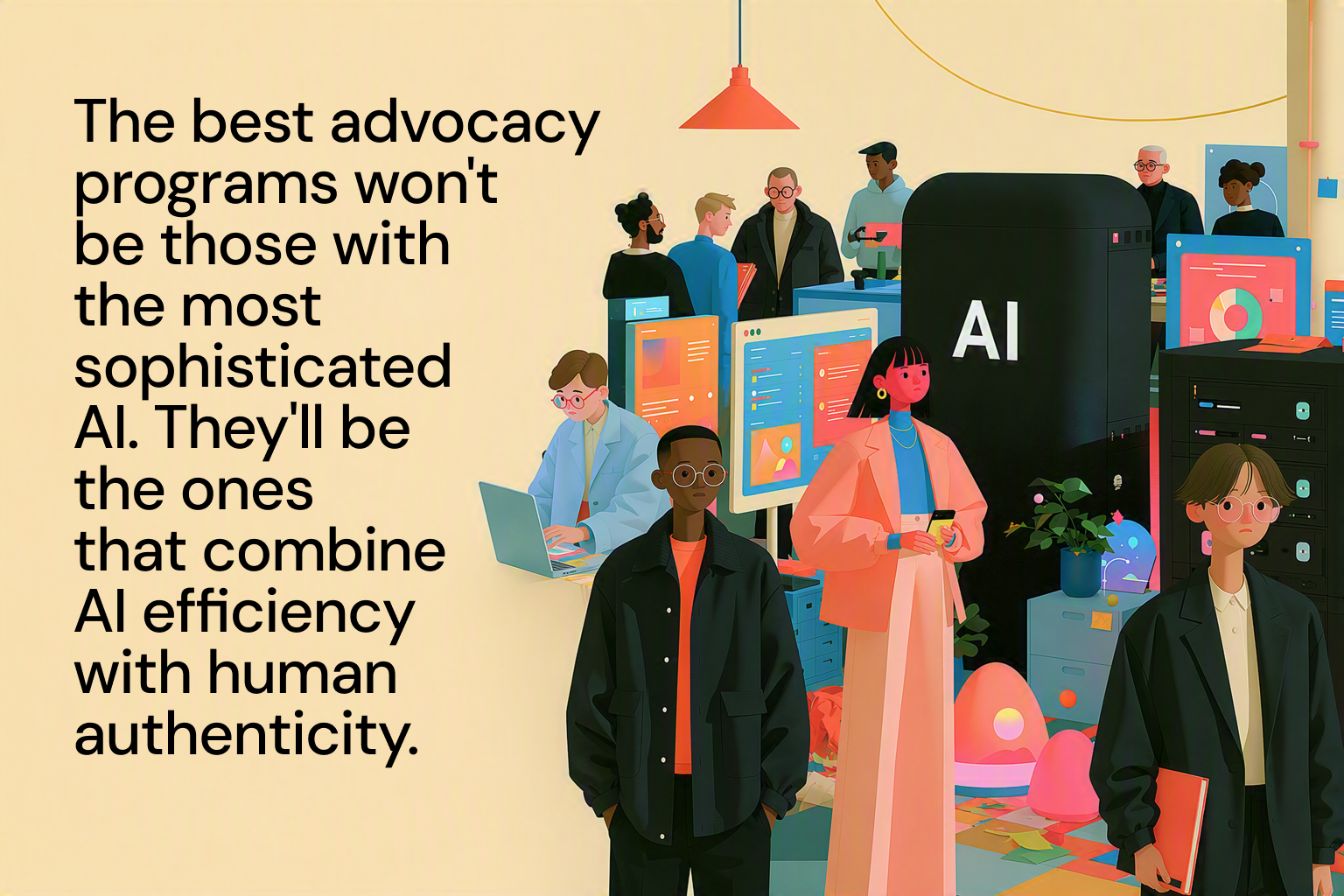
The best advocacy programs won't be those with the most sophisticated AI. They'll be the ones that combine AI efficiency with human authenticity.
AI will handle the friction, humans will provide the credibility.
AI will help employees start, humans will supply the experience, judgment, and perspective.
In other words, the future of employee advocacy looks remarkably human.
How Haiilo helps
At Haiilo, we see advocacy AI as a way to remove barriers, not replace people.
Our AI-powered advocacy capabilities help employees create content faster, adapt messaging to their own voice, and share with greater confidence. At the same time, organizations retain the governance, approvals, and visibility needed to scale advocacy responsibly.
The result is more employees participating, better content being shared, and stronger reach built on authentic human voices instead of corporate broadcasting.
Because in an AI-powered world, trust becomes even more valuable. And trust still starts with people.
Frequently asked questions about advocacy AI
Advocacy AI uses artificial intelligence to help employees create, personalize, and share content more easily. It acts as a writing and coaching assistant, helping people participate in employee advocacy programs with less effort and more confidence.
No. The goal of advocacy AI is not to replace people. It helps remove common barriers such as writer's block, lack of time, and uncertainty about what to post. Employees still provide the expertise, opinions, and personal experiences that make advocacy credible.
Advocacy AI can suggest post ideas, draft captions, summarize content, improve writing, and adapt messaging to different audiences. This makes it easier for employees to share content in a way that feels authentic to them.
Not necessarily. Authenticity comes from the individual sharing the content. The most effective programs use AI as a starting point, while encouraging employees to add their own voice, perspective, and insights.
Advocacy AI can increase participation, help more employees become advocates, improve content relevance, and scale advocacy programs more effectively. When used responsibly, it helps organizations expand reach and build trust through real employee voices rather than relying solely on corporate messaging.
Find
your
flow
Bring communication, knowledge, and tools into one calm place — and help your people find their flow.