
Truth decay is real – and it will get worse



Most organizations are sitting on a lot of information. The question is, how much of it they can trust?
That sounds dramatic until you spend five minutes inside the average digital workplace. There are policies nobody has reviewed in years, onboarding guides that contradict each other, SharePoint pages that survived three restructures, PDFs everyone knows are outdated, and knowledge bases full of answers that may or may not reflect how the business actually works today.
And still, more content is published.
More updates, more documents, more announcements, and increasingly, more AI-generated summaries of documents nobody trusted in the first place.
For years, digital workplace strategies have optimized for publishing. The logic was simple: if people need information, give them more places to find it. In other words, more access.
But accessing information does not mean you can trust it.
An employee doesn’t just need to know whether information exists. They need to know whether it is current, accurate, approved, relevant, and safe to act on. That is where many organizations are falling apart.
Not loudly. Not all at once. Just through the slow accumulation of uncertainty.
Is this the latest policy? Is this process still followed? Who owns this page? Why does this document say something different? Has anyone checked this since the reorg? Should I trust the intranet, my manager, the Teams chat, or the spreadsheet someone made because the official system was too painful to use?
This is “truth decay” at work.
What is truth decay?
It is not misinformation in the dramatic, headline-grabbing sense. It is something more mundane and more dangerous: the gradual erosion of confidence in what the organization knows.
And employees respond exactly as you would expect. They build workarounds.
They ask the person who has been around longest. They message the colleague who “usually knows.” They rely on team folklore. They keep their own copies. They ignore official sources because experience has taught them that “official” does not always mean “right.”
The organization keeps publishing information, and employees keep looking somewhere else for the truth.
That should make leaders uncomfortable. Because once trust breaks, adding more information does not fix the problem. It usually makes it worse.
Now AI is about to make that impossible to ignore.
The AI magnifier
Most AI conversations at work still orbit the same shiny objects: agents, assistants, models, prompts, productivity gains. Useful conversations, sure. But incomplete.
Because AI doesn’t know what’s true inside your organization. It doesn’t know that the onboarding guide from 2022 is ignored by HR. It does not know that the “official” policy was replaced in practice six months ago. It does not know that one document is trusted, another is tolerated, and a third should have been deleted before the pandemic.
AI does not understand organizational truth. It understands available information.
That distinction matters.
If your workplace is full of duplicated, outdated, ownerless, contradictory content, AI will not magically turn that into wisdom. It will turn it into answers. Fast answers. Polished answers. Confident answers. Sometimes wrong answers that sound more credible than the messy human explanation ever did.
That is the real risk.
Not that AI hallucinates from nothing – that is the obvious and overblown fear. The deeper risk is that AI faithfully reflects the mess you already have, then scales it across the business.
AI readiness isn’t about AI
Bad knowledge used to move at human speed. Now it moves at machine speed.
Before AI, an outdated policy might confuse one employee, frustrate one team, or slow down one process. With AI, that same outdated policy can influence thousands of searches, summaries, workflows, decisions, and employee interactions.
This is why AI readiness (*link to “what is readiness” blog) is not really about AI.
It’s about whether your organization can maintain truth.
Do you know which sources are authoritative? Do critical policies have owners? Is stale content removed or flagged? Are employees confident enough to act on what they find? Can your systems tell the difference between approved knowledge and abandoned content?
If the answer is no, then you do not have an AI strategy. You have an automation strategy built on a very serious trust problem.
Boring AI = good AI
The companies that see results from AI will not be the ones with the smartest tools. Everyone has access to smart tools. The advantage belongs to organizations with the healthiest knowledge foundations.
The ones that treat truth as infrastructure.
That means governance becomes more than admin. Ownership becomes more than housekeeping. Content quality becomes more than a communications concern. In an AI-powered workplace, these things directly shape productivity, confidence, adoption, and decision-making.
The boring stuff just became strategic.
For years, organizations have behaved as if knowledge could take care of itself. Publish it once, store it somewhere, hope people find it, hope it stays useful, hope the old version doesn’t cause too much damage.
That era is ending.
AI is forcing a reckoning with a problem employees have felt for years: the workplace is full of information, but short on trusted knowledge.
The future will not belong to the organizations that create the most content or buy the loudest AI tools. It will belong to the organizations that can answer a harder question:
Can our people, and our AI, trust what we know?
If not, that’s where the real work begins.
What is truth decay, and why does it matter?
Truth decay is the gradual loss of confidence in organizational knowledge. It happens when employees can no longer tell which information is accurate, current, approved, or safe to act on.
It builds up over time through outdated policies, duplicate content, abandoned intranet pages, conflicting guidance, and unclear ownership. Individually these issues seem small, but together they make employees question what to trust.
AI is raising the stakes. AI systems can only work with the information they're given. If your workplace knowledge is outdated or inconsistent, AI can spread those problems faster by generating confident answers from unreliable sources.
Not anymore. Trusted knowledge now directly impacts productivity, decision-making, employee confidence, and AI adoption. Organizations with poor knowledge foundations risk scaling confusion instead of efficiency.
True AI readiness starts with knowing which information is authoritative, who owns it, and whether it's up to date. Without that foundation, AI initiatives are built on shaky ground.
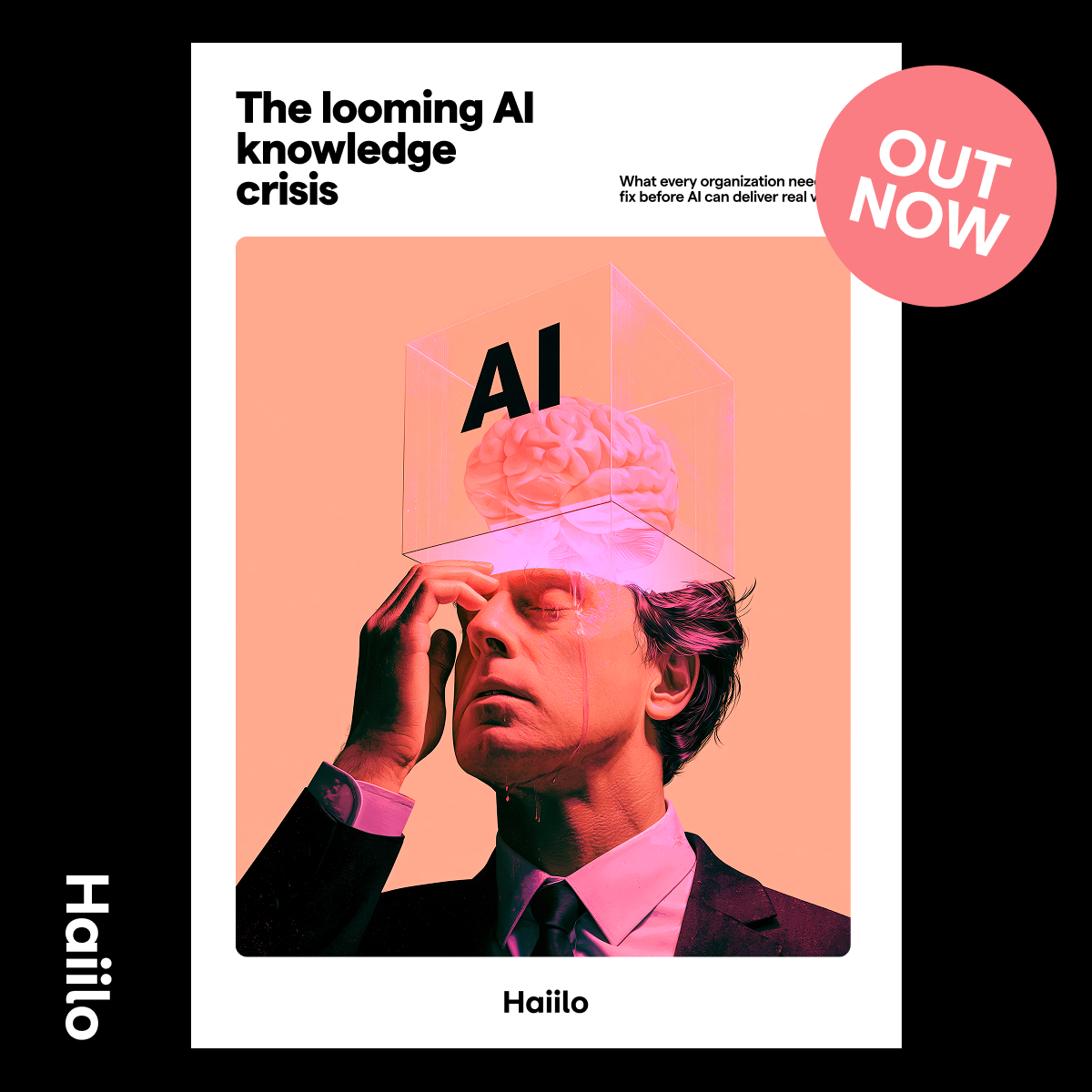
The looming AI knowledge crisis
Read all about it (and what to do next) in our latest report
Find
your
flow
Bring communication, knowledge, and tools into one calm place — and help your people find their flow.