
Trust In the Workplace: Why It Is Important and How to Build It



Trust in the workplace has been emerging as one of the most important topics among business leaders and HR professionals across the globe. As organisations become more distributed and fast-moving, creating a trusted workplace is no longer a “nice to have”—it’s essential for how teams collaborate, communicate, and perform.
According to the Edelman “Trust Barometer”, there is a growing gap between how organisations operate and how employees perceive trust in their workplace. Many employees feel uncertain about leadership decisions, transparency, and how change is managed. This creates a ripple effect across engagement, motivation, and morale, making it harder for teams to stay aligned and productive.
Get the IC platform that helps you boost transparency and trust in the workplace!
In the same Edelman research, it was also discovered that trust decreases from top positions to the lowest. For instance, 64% of executives trust their organizations, while only 51% of managers and 48% of other staff trust their organizations.
In other words, employees trust their peers more than the CEOs and upper-level executives. The higher up you go, the more critical it is for you to build trust with those that you supervise.
In this blog, you will learn more about the importance of trust in the workplace, as well as some best practices around how to build and maintain trust.
Top Reasons Why Building Trust in the Workplace is so Important Today
Some of you may already have experienced working in a workplace where people are unreliable, disengaged, disloyal or uncommunicative. If so, you know how hard it is to strive and be successful within such a working environment. This is exactly how employees who work in low-trust workplaces feel.
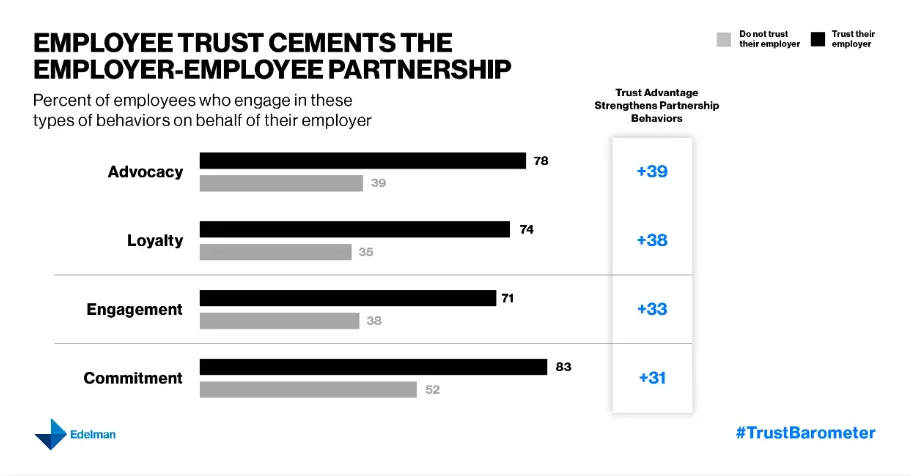
A negative working atmosphere creates a highly stressful and undesirable environment for everyone. Within such organizations, employees withhold their talents, creativity, energy, and passion. Over time, this doesn’t just affect morale—it leads to slower decision-making, weaker collaboration, and missed opportunities. As a result, organisations struggle to maintain productivity, lose their innovation capabilities, and gradually weaken their competitive edge.
Let’s take a look at some examples and insights from Harvard Business Review, SHRM, Great Place to Work, and Harvard Business School that highlight the benefits of building a highly-trusted workplace.
Trust enhances teamwork and collaboration
Trust in the workplace has a direct impact on how employees collaborate and work together on shared goals. When trust is present, teams communicate more openly, share knowledge more freely, and resolve issues faster. Research shows that trust sits at the core of high-performing teams and shapes how people collaborate day to day.o-face interaction, teams rely heavily on communication and transparency to stay aligned. Studies on remote work show that communication gaps and reduced personal connection can quickly erode trust if they are not addressed.
In most cases, poor employee communication and the lack of sense of community in the workplace are the reason number one for poor collaboration. When people feel disconnected, they are less likely to contribute ideas, ask questions, or support others. The first step towards building trustworthy and collaborative workplaces is to drive open and honest communication that employees can rely on. This is what ultimately enables a truly trusted workplace to take shape.
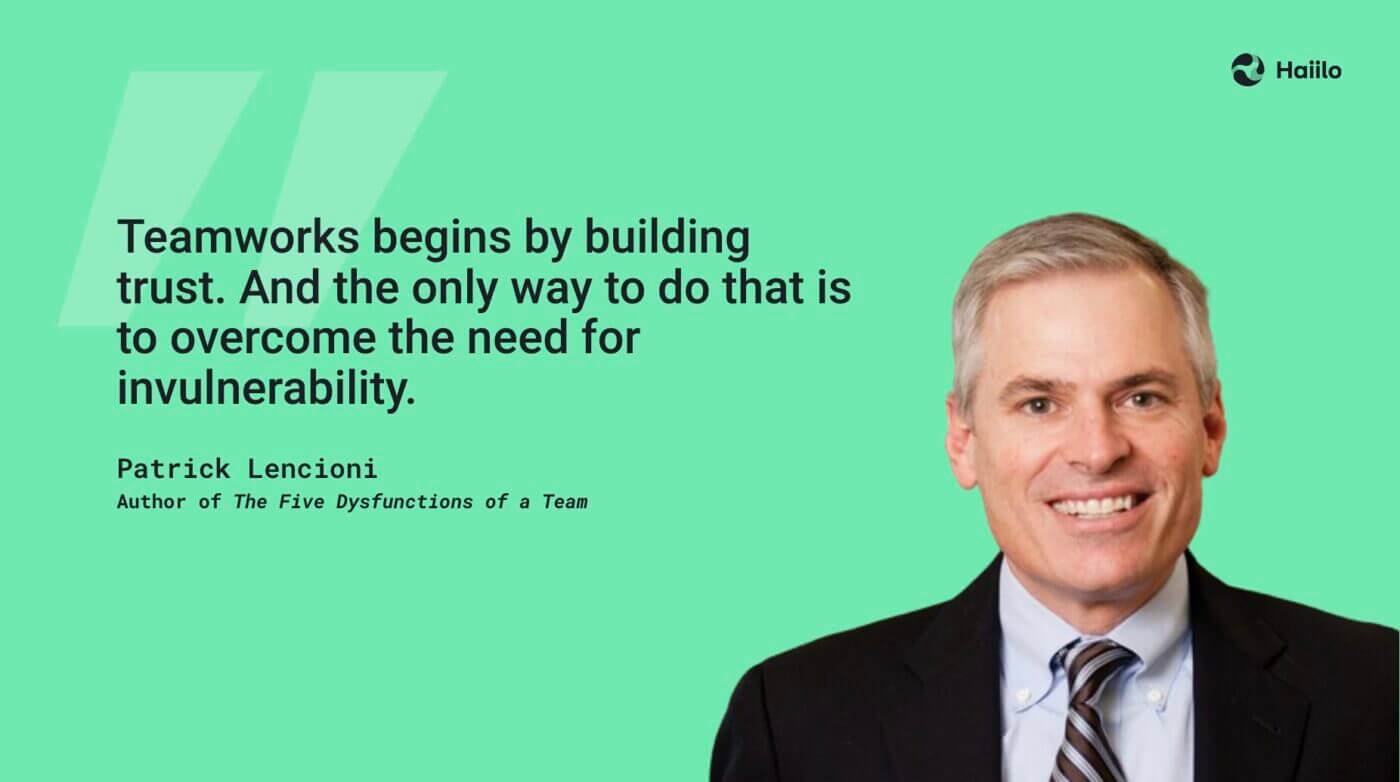
Trust improves organizational alignment and a sense of belonging
When employees trust their employers, they are much more likely to work together toward achieving the same ultimate business goals, and they are more likely to feel like they belong to their organization.
Yet, such organizational alignment is not easy to achieve, especially in large enterprise organizations with offices around the world. In order to have all the employees on the same page, organizations must do a much better job communicating their core company values, mission, and vision to their employees.
Trust improves efficiency, engagement, and productivity
Let’s take a look at some numbers from the previously mentioned sources. According to research, disengagement costs U.S. companies approximately $450 billion to $550 billion annually.
What does this have to do with trust in the workplace? A lot!
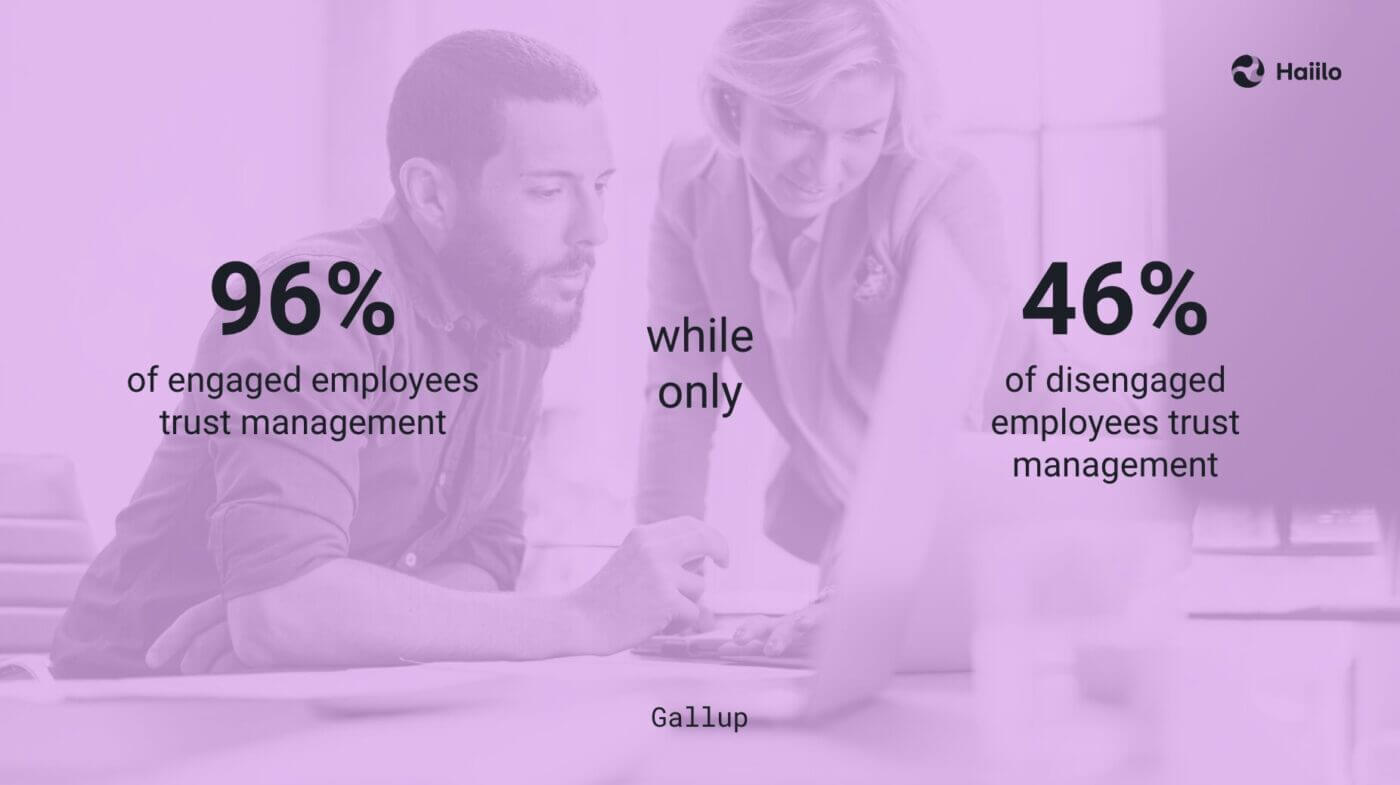
Indeed, 96% of engaged employees trust management, while 46% of disengaged employees trust management.
Besides engagement, research shows that highly-trusted workplaces enjoy:
- Higher employee productivity
- More energy and commitment at work
- Fewer sick days and absences
To add, companies with strong trust cultures tend to outperform those where trust is low, as employees are more willing to contribute, collaborate, and go beyond their core responsibilities.
Trust enhances decision-making
Within highly trusted workplaces, trust goes both ways. Meaning employees put trust in their superiors and other executives, while managers trust their teams.
When such synergy happens, managers are more likely to empower their employees to make their own decisions, and employees have the confidence and clarity to act on them. This reduces bottlenecks, speeds up workflows, and improves overall responsiveness across the organisation.
Trust decreases stress and burnout in the workplace
Employees who trust their employers tend to feel more secure, supported, and informed. When people understand what’s happening and feel included, uncertainty drops—and so does stress.
As stress and burnout have many negative impacts on motivation and performance, employers are increasingly focusing on how to prevent them. Building a trusted workplace plays a key role here.
As trust starts with open communication, employers need to find ways to create company cultures that foster transparency. Regular, clear updates help employees stay aligned and reduce unnecessary anxiety across teams.
📹 Check out our Masterclass to learn about how to overcome communication barriers in the workplace!
Trust increases employee loyalty and retention
Employee burnout is often followed by employee turnover. When people feel unsupported or disconnected, they are more likely to look elsewhere for stability and growth.
On the other hand, in a trusted workplace, employees feel safer speaking up, sharing concerns, and engaging with leadership. This strengthens relationships and reduces the likelihood of silent disengagement.
To add, employees are more likely to stay longer with organisations where leaders follow through on their promises and communicate openly. Consistency and transparency build confidence over time, making retention a natural outcome rather than a forced effort.
Trust overcomes resistance to change
During the previous pandemic, many employers had to go through significant changes in their operations and Human Capital Management.
Adjusting to remote work wasn’t easy for everyone. It required organisations to adapt quickly and align their entire workforce with new initiatives. But most people don’t like change, especially when they don’t understand the reasons behind it.
Like many other examples, internal communications play a crucial role in communicating the importance of change and guiding people through it.
When communication is effective, trust in the workplace increases, making employees more confident in decisions and more open to change.
Trust improves innovation and creativity
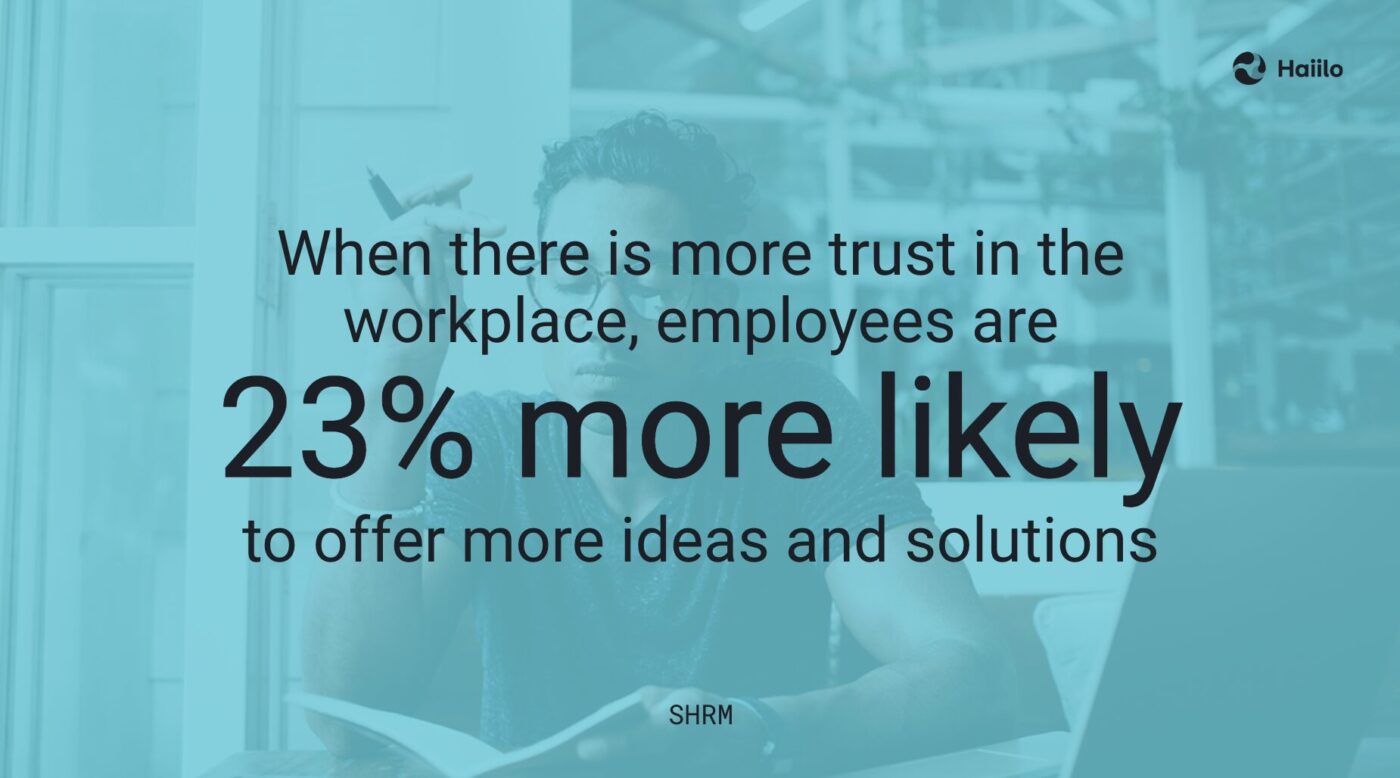
When people feel comfortable sharing ideas and challenging the status quo, innovation becomes part of everyday work. In a trusted workplace, employees are more likely to speak up, test new approaches, and collaborate on solutions.
Trust creates psychological safety. It removes the fear of being wrong or judged. As a result, teams generate more ideas, solve problems faster, and drive continuous improvement across the organisation.
Remember, promoting a culture of trust rather than fear encourages collaboration and builds a creative workplace. When employees are afraid to make mistakes or have a fear of being punished, they are far less likely to take initiatives, yet risk is essential to innovation.
8 Ways to Build Trust in the Workplace
In its global CEO survey, PwC reported that 55% of CEOs think that a lack of trust is a threat to their organization’s growth.
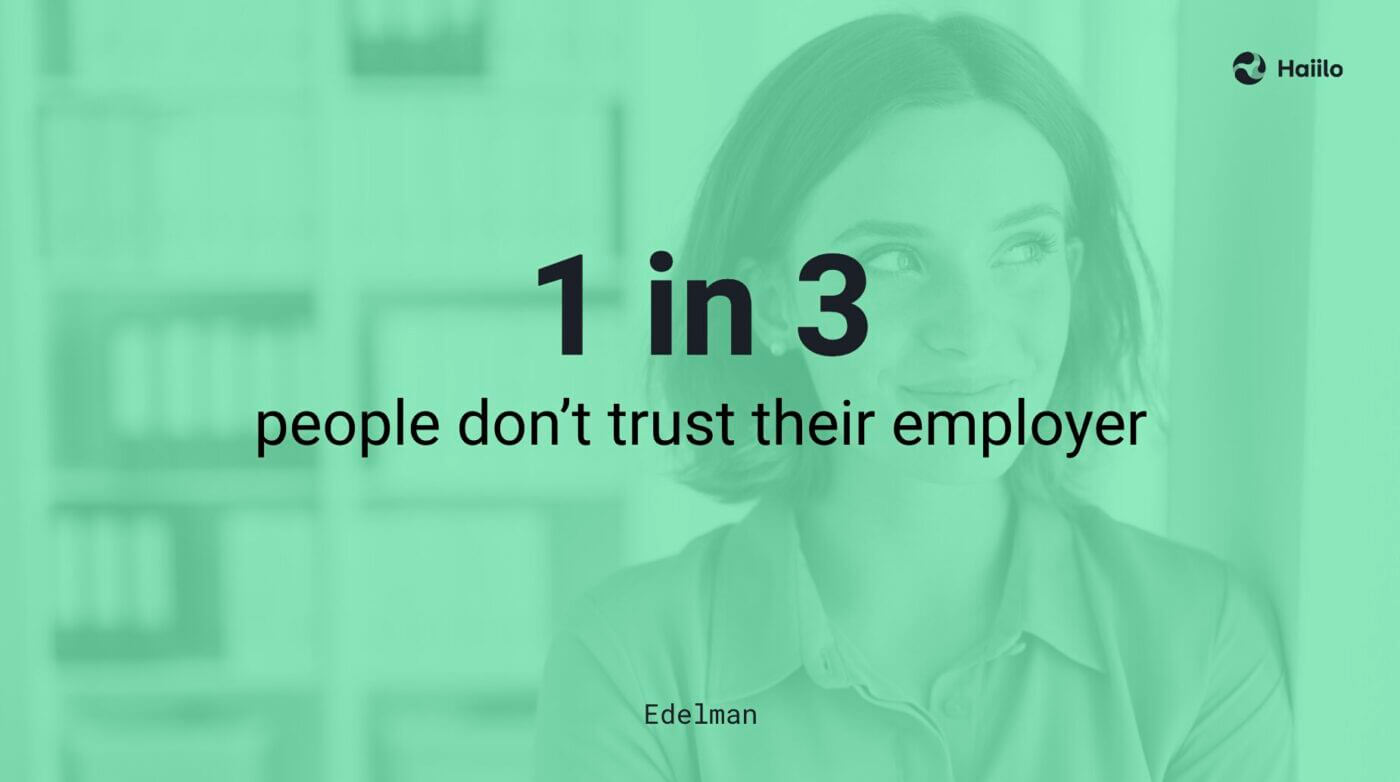
Even though the importance of trust in the workplace appears to be self-evident for most organizations, many are still unsure how to achieve it. Remember, one in three people don’t trust their employer.
The thing is, business leaders are now facing new challenges: building trust when teams are geographically dispersed. Remote and hybrid work have changed how people communicate, collaborate, and stay connected. Without regular face-to-face interaction, it’s easier for misunderstandings to happen and harder to maintain alignment. As a result, organisations need to rethink how they build and sustain a trusted workplace in this new environment.
So let’s now take a look into what you can do to create a highly trusted workplace, especially now remote work is the new normal.
1. Encourage employees’ share of voice
58% of employees believe they are responsible for ensuring their own career success. Yet 63% of employees feel that employers have too much control over their professional lives and well-being.
When employees feel a lack of control, it becomes much harder to build trust. They may hesitate to share ideas, raise concerns, or fully engage with their work.
To address this, employers must give employees a voice. This means creating real opportunities for input, encouraging feedback, and making information accessible. Employees need to feel they can speak up about important issues, share ideas, and be heard without fear of negative consequences.
One common mistake is relying on one-way communication. Sending updates without inviting responses limits engagement. A truly trusted workplace is built through dialogue, not broadcasts.
2. Create a better company culture with open and transparent employee communications
Studies show that organisations that prioritise openness and transparency are more likely to outperform their peers. Clear communication helps employees understand decisions, align with goals, and feel included in what’s happening across the business.
Unlike traditional hierarchical organisations, modern companies are intentionally incorporating openness and transparency into their workplace cultures.
Transparency goes beyond sharing updates. It includes being honest about challenges, setting clear expectations, and giving consistent feedback. Practices like keeping employees informed and connected help create a sense of stability and belonging.
Without transparency, employees fill in the gaps themselves. This often leads to misinformation, uncertainty, and frustration—especially in distributed teams.
3. Share important information with your employees
Topics around trust and transparency become even more important during times of uncertainty. When employees lack clarity about what’s happening in the business, they can feel anxious and disconnected.
At the same time, many employees are dealing with information overload. When employees don’t get the right information, struggle to find it, or receive too much irrelevant content, both trust and productivity suffer.
To build a trusted workplace, organisations need to focus on delivering the right information at the right time. This means prioritising clarity, reducing noise, and making it easy for employees to access what they need. When communication is structured and relevant, employees feel more confident, informed, and ready to contribute.
Employers have to find better ways to keep their employees informed about the important company updates as well as updates from other relevant and trusted sources. Many of them still haven’t found ways to inform their employees in a timely manner and make communication more personalized.
4. Foster peer-to-peer communication
A great research by Edelman shows that the most common source of workplace information is other employees (37%), even more than personal communication from one’s manager (35%). Therefore, keeping employees connected and enabling them to communicate efficiently not only does build trust among employees, but it also creates better relationships and empowers knowledge sharing in the workplace.
Yet, many organizations’ employee communications ecosystems are very complex and, therefore, highly unproductive. When employees have to deal with and pay attention to multiple different communication channels, the chances for frustration and important information getting lost are very likely.
Consequently, your employees may feel uninformed, lost and confused. Therefore, employers need to switch to more centralized employee communication solutions that have the ability to connect multiple communication solutions into a single platform that serves as a source of relevant information.
5. Authentic and approachable leadership
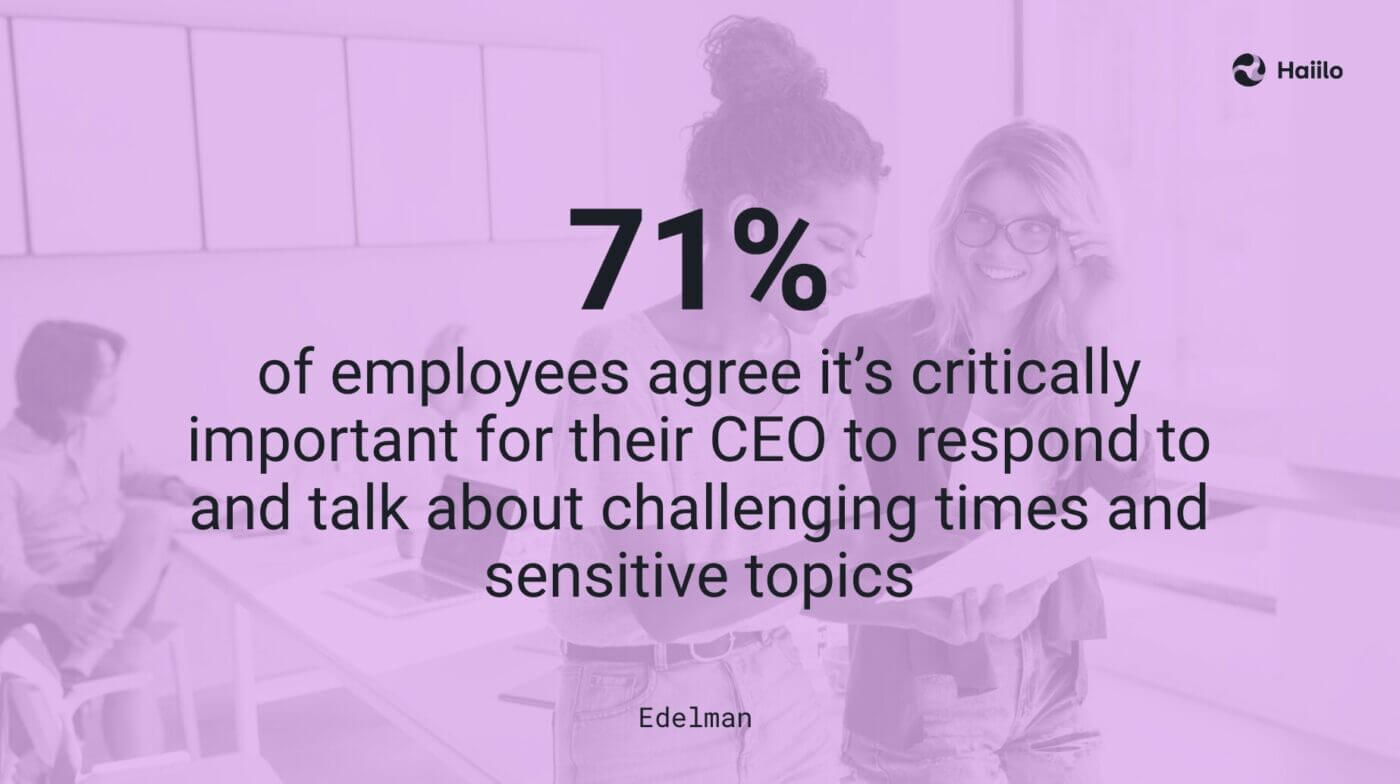
The same Edelman research showed that 71% of employees agree it’s critically important for their CEO to respond to and talk about challenging times and sensitive topics. We all have witnessed this during these hard times that COVID-19 has brought to us.
Therefore, building trust starts with leadership.
A recent Harvard Business Review study highlights that trust in leadership is built through consistent behaviour, clear decision-making, and strong relationships. When leaders are predictable, fair, and approachable, employees are more likely to rely on them and follow their direction.
This ultimately shows that a leader who communicates with an authentic voice and has a clear vision is more likely to be trusted and supported across the organisation. Employees don’t just listen to what leaders say—they watch what they do. When actions match words, trust grows. When they don’t, engagement and commitment quickly drop.
6. Create a sense of purpose and belonging
Because employees are looking for stability in an uncertain world, businesses now have an opportunity to clearly define what they stand for and why their work matters.
Edelman research found that many employees are actively seeking more meaningful work and a stronger sense of purpose. In fact, a significant number say they would reconsider working for an organisation that lacks clear values or societal impact. 42% of employees also say they would require significantly higher pay to stay with an organisation that doesn’t offer this sense of purpose.
Without these trust-building efforts, employers risk losing their best talent and weakening their culture. A trusted workplace is one where employees feel connected not just to their role, but to a wider mission.
7. Engage your employees in change management and digital transformation efforts
Employers should partner with their employees during periods of change. As mentioned before, many people are naturally resistant to change. However, instead of excluding employees from these processes, organisations need to engage them early and often in order to earn their trust.
This means being clear about where the organisation is heading, explaining why changes are happening, and listening to employee concerns. It also includes providing the right training so employees feel prepared for what comes next.
Leading transformation in the workplace is not easy, and effective communication is often the difference between success and failure. When employees feel informed and involved, they are far more likely to support new initiatives.
However, there is still a gap. Only 38% of employees say their employer communicated effectively during workplace transformations, and just 36% feel their organisation was honest about upcoming changes.
This highlights a clear opportunity. By improving transparency and involving employees more directly, organisations can strengthen trust, reduce resistance, and build a more resilient and trusted workplace.
8. Adopt the human-centric approach and enhance employee empowerment
Within the context of change and transformation, employers are only partially delivering the information employees need to co-create and be successful.
Employee-centric workplaces are the ones where trust levels are high. In order to have your employees believe in what you say and work with you towards the same goals, you need to put your people first and make them feel more empowered.
When employees’ expectations around how they think people should be treated are higher than what employers actually deliver, the trust is hurt and employees don’t feel empowered.
The image below from Trust Barometer is a great representation of the current gap between employees’ expectations and employers’ actual deliverables.
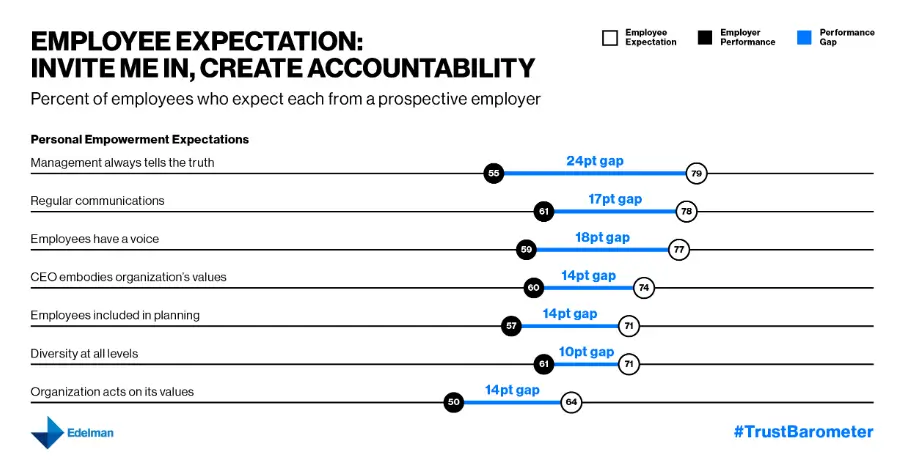
Only when you close this gap can you expect your employees to genuinely trust you and the decisions you make. Building a trusted workplace depends on aligning what leaders say with what employees experience every day.
9. Care about the psychological safety of your employees
A psychologically safe workplace is a place where employees feel safe and encouraged to share their ideas, express concerns, ask questions, suggest improvements, and learn from mistakes. It’s a workplace where employees know they can speak openly without fear of retribution, punishment, or embarrassment.
In a positive workplace culture, psychological safety allows people to contribute more freely and collaborate more effectively. Employees are more willing to take initiative, challenge assumptions, and support one another. This kind of environment not only strengthens relationships but also helps create a more resilient and trusted workplace.
On the other hand, the absence of psychological safety can quickly damage both culture and performance. Teams become quieter, issues go unaddressed, and employees are less likely to engage with their work or colleagues. Over time, this can lead to negative impacts on employee well-being, including higher stress levels, burnout, and increased turnover.
Ultimately, when employees feel safe, heard, and supported, they are more likely to trust the organisation and actively contribute to its success.
How To Measure Trust In the Workplace
Before you begin to invest into initatives to improve trust in your workplace, it is critical that you understand the current state of trust among your employees. The best way to measure the level of trust in your organization is by distributing a simple survey.
Here are some survey question examples that can help you better understand how much your employees trust their employers and leaders:
Employer
- I have positive feelings about the future direction of [company name]
- I feel like I can honestly express my opinion at [company name]
- I do my job knowing that [company name] will recognize my work
- Employees commonly believe that they are treated fairly at [company name]
- I feel that information can be shared openly within [company name]
Manager
- I feel that my manager listens to what I have to say
- I do my job knowing that my manager will keep his/her word
- I feel that my manager is available when needed
- I believe that my manager acts on my feedback
- I feel that my manager trusts his employees to work without excessive supervision and micromanagement
FAQ
What makes a trusted workplace in today’s hybrid environment?
A trusted workplace is built on consistency, transparency, and open communication. In hybrid teams, this also means making information easy to access and keeping everyone aligned, no matter where they work. Tools like a social intranet or employee communications platform can help ensure updates are visible and clear, reducing confusion and building trust over time.
How can leaders build trust with remote or distributed teams?
It starts with clear expectations and regular check-ins. Leaders should share updates early, explain decisions, and encourage feedback. A trusted workplace depends on two-way communication, not just top-down messaging. Practical steps like improving workplace communication and creating stronger connections through virtual communication strategies can make a big difference.
What are the biggest barriers to building a trusted workplace?
Poor communication, lack of transparency, and limited collaboration are the most common issues. When employees feel disconnected or unheard, trust quickly breaks down. This is especially true in siloed teams. Encouraging teamwork through initiatives like cross-functional collaboration helps create shared understanding and stronger relationships.
How does a trusted workplace improve engagement and retention?
When employees trust their organisation, they are more likely to stay, contribute ideas, and support business goals. A trusted workplace creates a sense of belonging and purpose, which directly impacts motivation. Strategies such as internal marketing, supported by tools like insights and analytics or employee advocacy platforms, can help you measure sentiment and keep employees actively involved.
Find
your
flow
Bring communication, knowledge, and tools into one calm place — and help your people find their flow.