
Bad communication is killing engagement. How internal communication employee engagement fixes it



Improving employee engagement is one of the top priorities for today’s employers. And for good reason. When employees don’t feel connected, motivated, or informed, performance suffers across the board. In this blog post, we explain how better internal communication employee engagement can help you create stronger connections and drive meaningful engagement.
According to Gallup’s latest State of the Global Workplace research, 71% of executives say employee engagement is critical to organisational success.
Yet the reality is very different. Gallup’s 2024–2025 data shows that only around 21% of employees worldwide are engaged at work. That means most employees feel disconnected, unclear, or unmotivated. In this blog post, we explain how you can tackle this gap and strengthen employee engagement through effective internal communications.
Why Improving Employee Engagement Should Be Your #1 Priority?
Employee engagement has been a buzzword in the business world for years — and for good reasons. Behind the hype, the impact is measurable and significant.
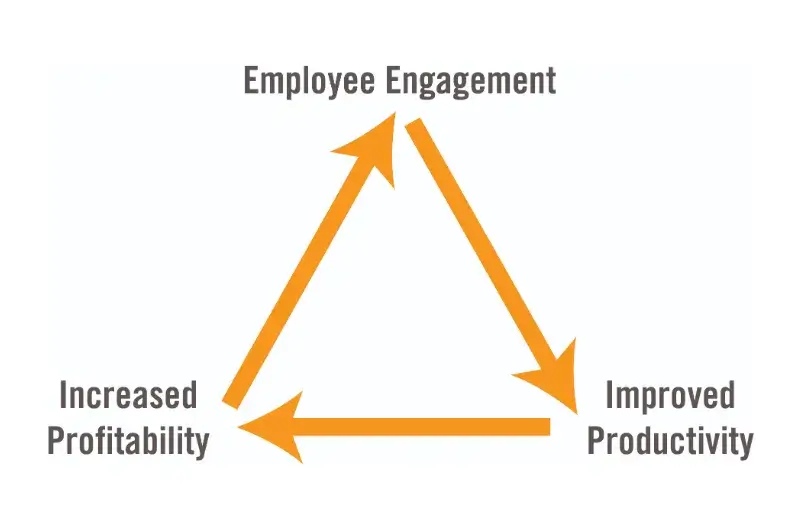
When employees are engaged, they don’t just work harder. They work with purpose. Gallup research shows that teams with high engagement deliver up to 17% higher productivity and 23% higher profitability compared to disengaged teams. Engagement directly affects performance, retention, and long-term growth.
So, how do you improve employee engagement in a sustainable way?
It starts with your internal communication strategy. If employees struggle to find information, miss important updates, or feel left out of decisions, engagement quickly drops. Clear, consistent communication gives people context, direction, and a sense of belonging — all essential for strong internal communication employee engagement.
Let’s now take a closer look at how improving internal communications can boost employee engagement and help your organisation perform at its best.
Improving Employee Engagement is Critical to Your Business Success
Many people still assume that employee engagement is the same as employee motivation or employee satisfaction.
It isn’t. While these concepts are connected, they are not interchangeable. Understanding the difference is essential if you want engagement efforts to actually work.
So, what do we mean by “employee engagement”?
In simple terms, it reflects how emotionally connected employees feel to their work and how committed they are to the organisation they work for. Engaged employees don’t just complete tasks. They care about outcomes.
Highly engaged employees are far more likely to go the extra mile. They put in discretionary effort, support their colleagues, and make decisions that benefit the organisation — not just themselves.
The 4 Levels of Employee Engagement
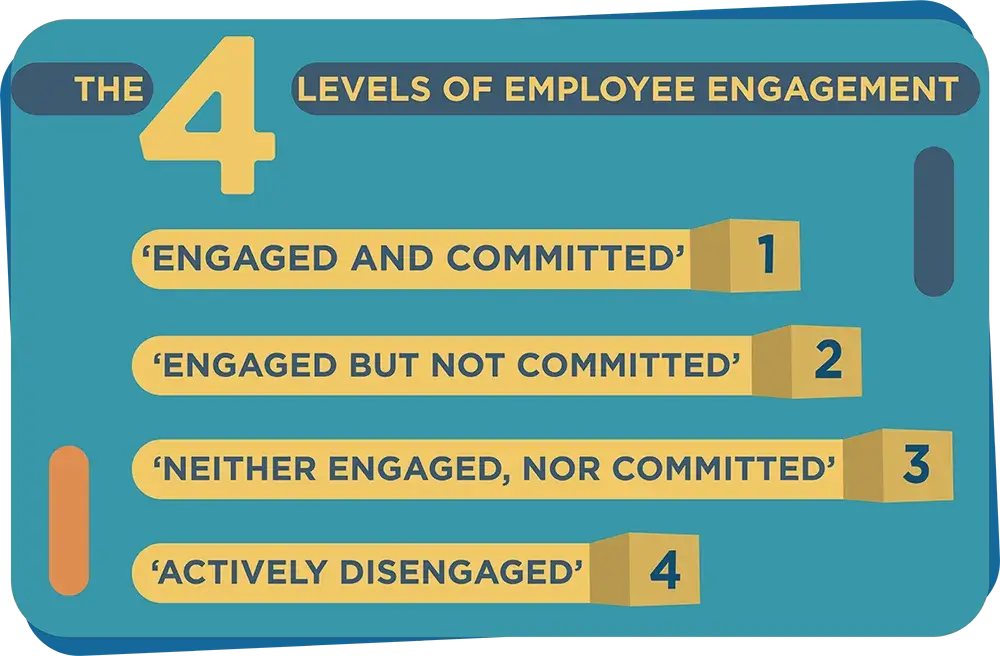
Source: Gallup
They’re more productive, less likely to miss work, they share the company’s values, and they take greater ownership of their work. Engaged employees are more proactive, collaborate better with colleagues, and are more invested in solving problems before they escalate.
But why is employee engagement so important to any business? The answer is simple: employee engagement is key to making your business a success. Recent research consistently shows that engagement has a direct impact on performance, retention, and business outcomes. Strong internal communication employee engagement plays a critical role here, because employees who feel informed and listened to are far more likely to stay committed and perform at their best.
Internal Communications Improve Employee Engagement
Boosting internal employee communications is one of the most effective ways to improve employee engagement. When a company has a clear internal communications strategy, employees understand what is expected of them, where the organisation is heading, and how their work contributes to shared goals. This clarity builds trust, confidence, and motivation.
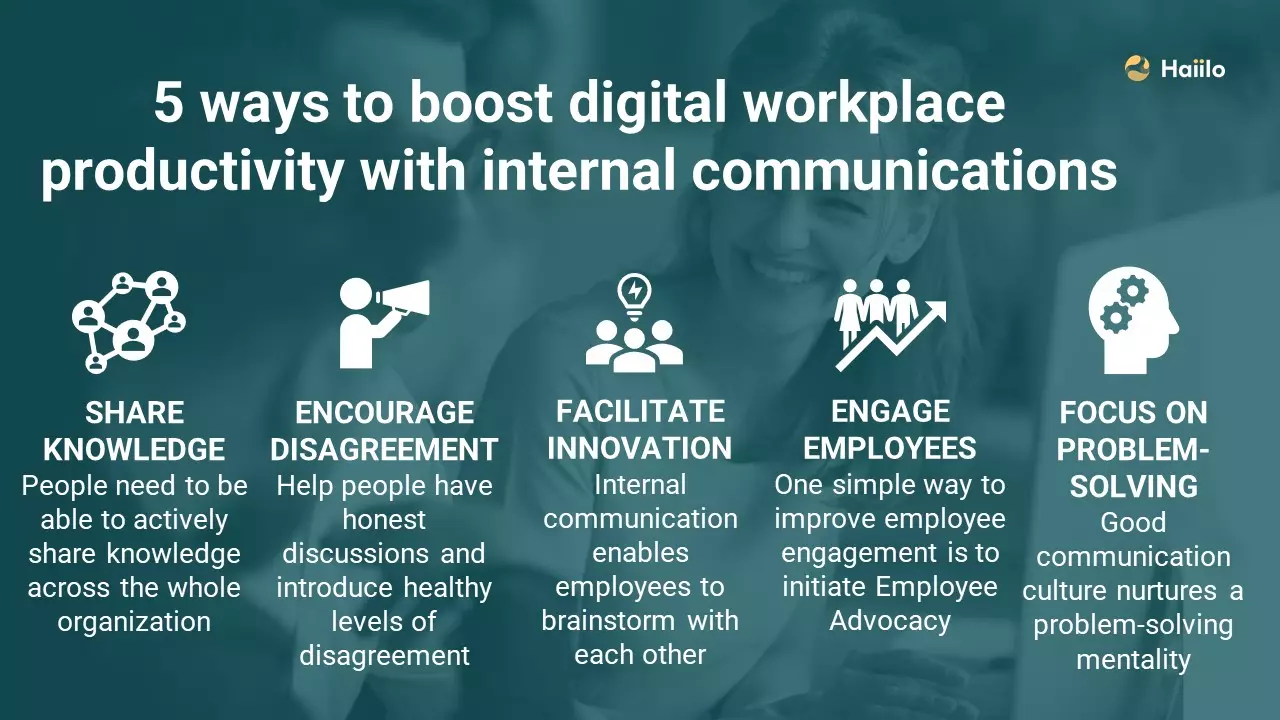
Here are just a few reasons why internal comms play such a big role in improving employee engagement.
In addition, there are many other ways internal communications can increase productivity, from reducing unnecessary meetings to helping teams focus on what matters most.
Open Communication Helps Employees to Feel Valued
Good internal communications start with managers. Fostering an open, two-way line of communication between employees and their supervisors helps employees feel listened to and respected, not just managed. This sense of inclusion plays a direct role in internal communication employee engagement.
Reaching this level of openness in internal communications requires consistent effort, not one-off initiatives. Managers need to communicate clearly, listen actively, and follow through. When they do, trust grows. And that trust makes everyday collaboration easier. Here’s what to aim for:
- Employees should feel comfortable going to management with problems, questions, or ideas.
- Employees should feel confident that managers are being open and transparent with information that affects their work.
- Managers should feel confident that employees will raise concerns early and share relevant professional content with colleagues, whether it relates to the company or the wider industry.
When these conditions are met, employees are far more likely to feel valued at work and to stay engaged long term. How valued? Well, 37% of employees say that recognition for their work is the most meaningful way a company can support them.
On the other hand, when communication with management is poor or inconsistent, employees often feel anxious, distracted, and out of the loop.
They’re less likely to share insights or speak up, and more likely to withdraw from their work and their team.
Over time, tension replaces trust. The relationship itself becomes the problem, not the work. The work environment becomes negative, which increases the risk of disengagement.
Effective Internal Communications Increase Efficiency
Having to jump through hoops to complete everyday tasks is frustrating. Yet in many organisations, this is seen as normal.
When organisations don’t communicate effectively, unnecessary complexity builds up fast. Simple actions – like finding the right contact in another department or getting clarity on priorities – turn into time-consuming obstacles. Clear, well-structured internal communications remove this friction and help employees focus on the work that actually matters.
Source: Gallup
When employees feel that processes and systems work against them instead of supporting them, frustration builds quickly. Over time, this leads people to disengage emotionally. They do what’s required, meet minimum expectations, and mentally detach once the working day ends — which is rarely what any organisation wants.
However, when employees experience a workplace that encourages open, company-wide communication to share ideas and get work done, the dynamic shifts. Clear and inclusive communication helps people understand decisions, reduce friction, and contribute with confidence. This approach strengthens internal communication employee engagement by making employees feel aligned with how the organisation operates.
This sense of alignment is often described as culture fit — when employees genuinely connect with, adopt, or grow into the core values of the company. When communication supports those values in everyday work, engagement becomes easier to sustain.
The Virtuous Cycle of Internal Communications and Employee Engagement
Engaged employees are more likely to speak up in meetings, raise questions, and contribute ideas early. They don’t wait for permission to improve how work gets done.
They’re also more likely to communicate openly with supervisors, ask for feedback, and check in on their own performance. These behaviours keep communication flowing in both directions.
As communication improves, engagement grows. Employees begin to feel like part of a healthy, collaborative, and positive environment, not just a role or function.
Think about it this way: when employees regularly receive relevant information — such as company updates or industry knowledge linked to their expertise — they are better equipped to learn, adapt, and build new skills proactively.
And when employees are encouraged to stay informed about company news and share useful content with colleagues, they deepen their connection to the organisation’s mission and direction.
This creates a virtuous cycle of better internal communications leading to higher engagement levels, which then drives more open communication, stronger collaboration, and even higher engagement.
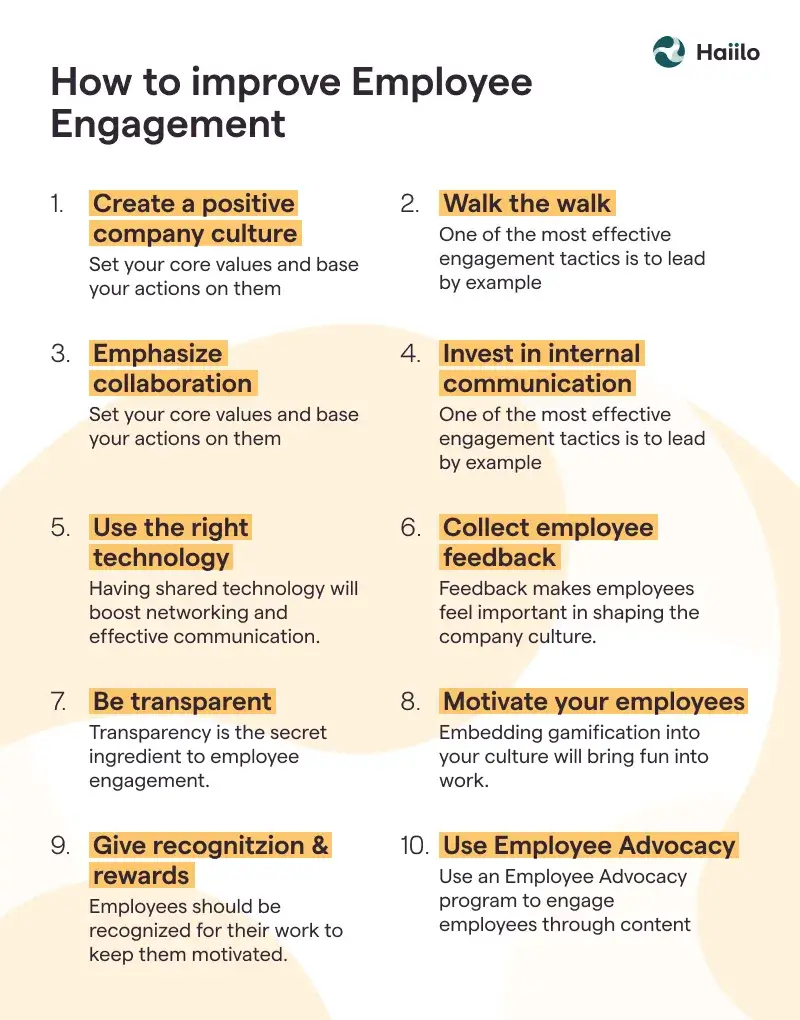
Top 10 Tips for Improving Employee Engagement
Since internal communications is not the only factor effecting employee engagement, we have made an infographic with top 10 tips for improving employee engagement.
Conclusion
Improving internal communications should be a top priority for business owners, executives, and team leaders in every industry. And while it may seem like a very distant goal for your organization, it is critical to your business success.
Even the lowest employee engagement numbers can be turned around — and like any relationship, it all starts with communication.
See the benefits of using Haiilo today
FAQs: Internal communication and employee engagement
1. How does internal communication affect employee engagement?
Internal communication plays a direct role in how engaged people feel at work. When employees understand company goals, receive timely updates, and know where to find information, they’re more likely to feel involved and valued. Poor communication, on the other hand, creates uncertainty and disconnect. Clear internal communication employee engagement relies on consistency, transparency, and two‑way dialogue, not just top‑down announcements. A shared space like a helps bring information, people, and conversations together in one place.
2. What are the biggest internal communication mistakes that hurt engagement?
The most common mistakes include information overload, unclear messages, and relying on too many disconnected tools. Employees stop engaging when they don’t know what’s relevant or where to look. Another issue is treating communication as one‑way. Engagement improves when employees can ask questions, give feedback, and contribute ideas. This is why a defined is essential for sustainable employee engagement.
3. How can leaders improve internal communication to boost engagement?
Leaders set the tone. Regular updates, honest messaging, and visible leadership all help build trust. But engagement grows faster when managers also listen. Encouraging teams to share insights, celebrate wins, and discuss challenges openly strengthens internal communication employee engagement. Structured employee communications, supported by platforms designed for this purpose, make these behaviours easier to maintain at scale. The use case shows how this works in practice.
4. Is internal communication enough to improve employee engagement on its own?
Internal communication is a key driver, but it’s not the only factor. Engagement is also shaped by culture, leadership, recognition, and growth opportunities. That said, strong communication connects all of these elements. It reinforces company values, supports a positive workplace culture, and keeps people aligned. For a broader perspective, our guide on and our insights on show how communication underpins long‑term engagement.
Find
your
flow
Bring communication, knowledge, and tools into one calm place — and help your people find their flow.