The cost of doing nothing: What your business loses without an employee advocacy solution


Your employees already have the audience. They have professional networks built over years, first-hand knowledge of your organisation and a level of credibility a corporate account cannot simply buy.
But without a purpose-built employee advocacy solution that remains hidden.
- Marketing teams chase people to share.
- Content is rewritten for different channels and regions.
- Approvals live in email threads and spreadsheets.
- Employees hesitate because they are not sure what is safe, relevant or worth posting.
Some activity still happens, but it is fragmented and its impact on reach, demand and revenue is difficult to prove.
That is the real cost of doing nothing. It is not simply the absence of a new tool. It is a recurring tax on time, budget, participation, control and growth.
Inaction is not free
A manual advocacy programme can look inexpensive because its costs rarely appear as one line in the budget.
Instead, they are spread across people, processes and missed opportunities.
The social media manager spends another afternoon preparing captions. Regional teams duplicate work. Legal reviews content with little context. Employees search across emails, chat tools and shared folders for the latest approved link. Marketing pays to replace organic reach it could have earned through its own people. Leadership sees posts and likes, but no credible value story.
The programme is technically “running”, yet the organisation is paying for it in several different ways.
1. Manual administration becomes a permanent productivity cost
Without a central workflow, advocacy depends on people remembering what to do next.
Someone must:
- Collect content
- Rewrite it
- Request approval
- Distribute it
- Answer questions
- Track participation
- Chase metrics if even possible
- Assemble the results
A simple way to expose the hidden cost is:
Cost = number of people involved × hours spent per week × loaded hourly cost × working weeks
For example, if two team members each spend five hours a week on manual advocacy work, at a loaded cost of €50 per hour over 46 working weeks, that is €23,000 a year before the value of missed campaign work is included.
2. You end up paying for ads to replace organic reach
Company pages primarily reach people who already follow the brand. Employees reach different communities: peers, customers, candidates, partners and potential buyers who may never follow a corporate account.
Employee-shared content can generate 561% more reach than brand-channel content. Without advocacy, a company is underusing distribution it already has.
All that unused organic reach is often replaced with paid media. The business pays for impressions and clicks while an existing network remains largely dormant.
Telia shows what this opportunity can look like in practice. Between January and October 2020, employee-shared posts reached 4.26 million people, averaged 8.5 clicks per post and saved the company an estimated $100,000 in equivalent social advertising costs. Its virtual-event attendance also grew 15-fold.
Doing nothing therefore creates a double cost: the reach you do not earn and the budget you spend to compensate for it.
3. You slow the buying process
In B2B, influence is distributed across a buying group. The people shaping a decision are not always the people filling out a form or joining a sales call.
According to a 2025 study by leading global strategic communications firm Edelaman, more than 40% of B2B deals stall because of internal misalignment within buying groups.
If your subject-matter experts, leaders and customer-facing teams are invisible online, your brand loses opportunities to build familiarity and credibility before a formal buying process begins.
Competitors whose people consistently share useful perspectives can become the familiar, lower-risk choice.
This is not an argument for turning employees into corporate megaphones. That usually makes the problem worse. It is an argument for helping people share relevant content in their own voice, with enough guidance to feel confident and enough freedom to remain credible.
4. Participation declines when sharing feels like work
Most employee advocacy programmes do not fail because employees actively oppose the idea.
They fade because the experience demands too much effort.
Employees must switch between systems, copy and paste text, find the correct link and work out whether a post is approved. The reward is unclear, while the personal risk feels immediate.
Organisations are effectively asking people to represent the brand without always giving them the confidence, examples or guardrails required to do it well.
Every extra step creates drop-off. When participation falls, the programme becomes increasingly dependent on a small group of enthusiastic advocates:
- Reach plateaus
- Content becomes repetitive
- Administrator spends even more time chasing
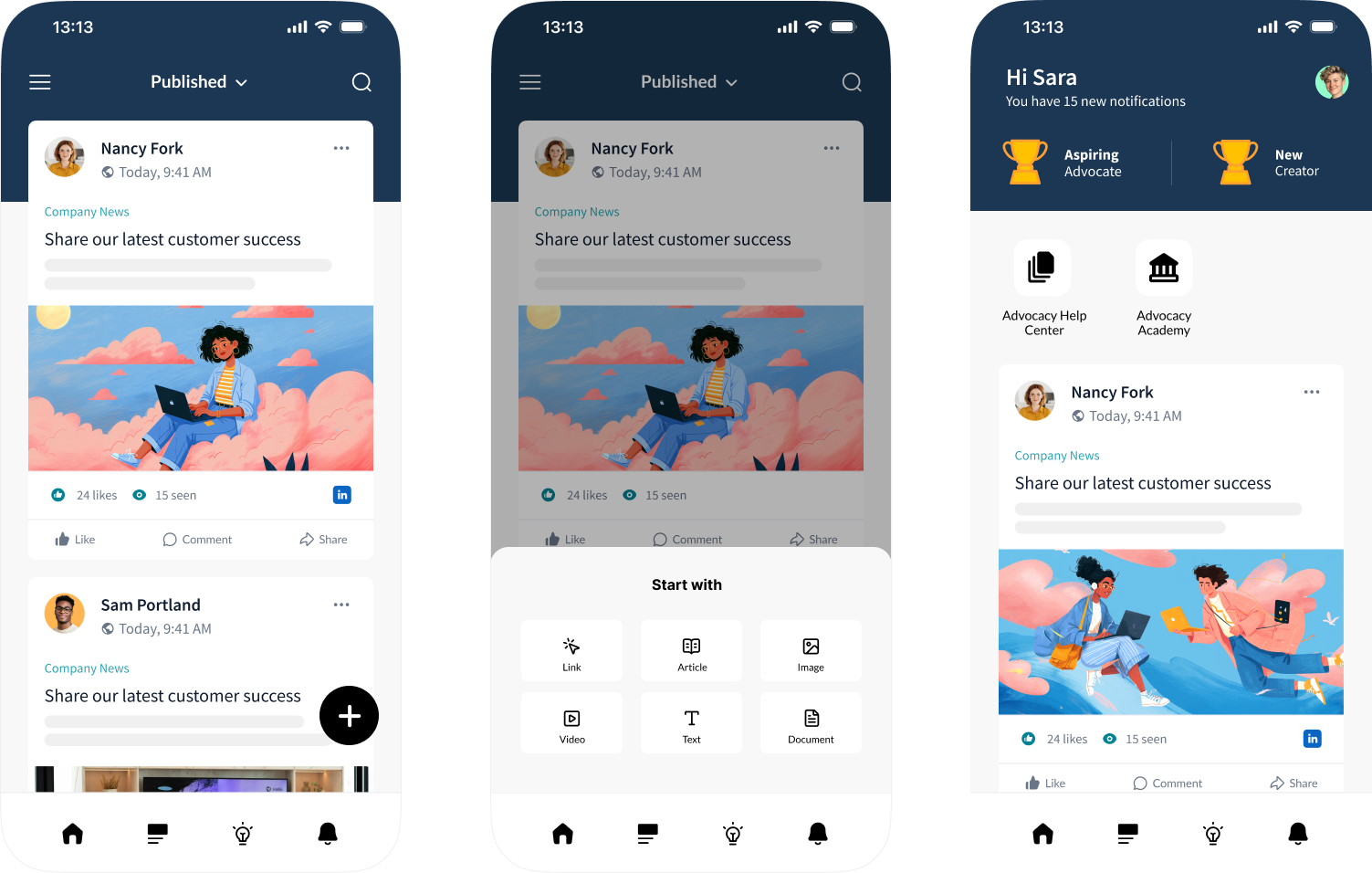
A scalable programme reduces that friction with
- Relevant content feeds
- Ready-to-share assets
- Optional caption suggestions
- Mobile access
- Clear guidance
AI can help people overcome the blank page, but employees should still be able to edit, personalise and retain a recognisably human voice.
5. Governance becomes either risky or restrictive
Manual advocacy forces organisations into a tough decision.
If controls are too loose, outdated or unapproved content can be shared. Employees may not know whether an asset, claim or customer reference is safe to publish.
If controls are too restrictive, every post waits for manual approval. Employees lose momentum and the programme slows to the point that people stop using it.
Email threads and spreadsheets are not governance systems. They make permissions, ownership and auditability dependent on individuals. This becomes increasingly fragile across multiple countries, languages, brands and regulated teams.
A purpose-built employee advocacy solution creates one governed workflow: approved content, defined roles, clear permissions and repeatable review processes.
The aim is not to control every word employees write. It is to make confident, compliant sharing easier than risky workarounds.
6. Activity remains visible, but value stays unprovable
Without integrated analytics, marketing can usually show that employees posted. It is much harder to show what those posts achieved.
Reach sits in one platform. Clicks sit in another. Participation is tracked in a spreadsheet. Earned media value is estimated manually. Campaign and pipeline influence may not be connected at all.
This creates a dangerous reporting gap. Leaders see effort, not impact. The programme is treated as a nice-to-have because the team cannot show its contribution in the language the business uses to allocate budget.
If you cannot see which topics, formats, regions or advocates perform best, you cannot reliably improve the programme. Teams continue producing content without knowing what drives reach, engagement or action.
A measurable advocacy channel should bring together
- Reach
- Impressions
- Engagement
- Clicks
- Shares
- Participation
- and most importantly earned media value.
What changes when advocacy becomes a managed channel?
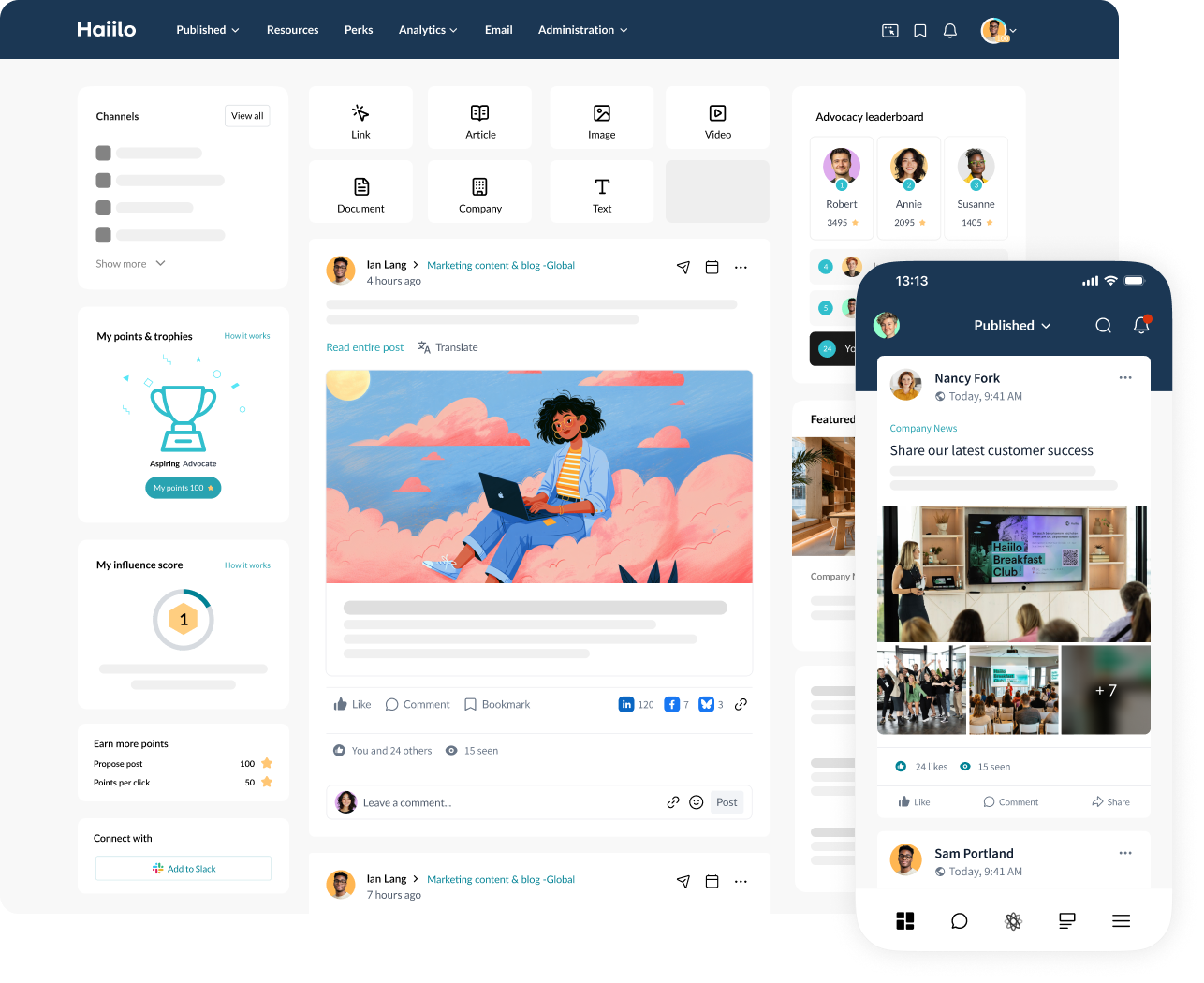
A purpose-built platform turns advocacy from a collection of tasks into a repeatable operating model:
- Content becomes easier to find. Employees have one place for current, approved content across desktop and mobile.
- Relevance improves. Teams can target content by role, region, language, topic or campaign instead of sending everything to everyone.
- Sharing becomes faster. Ready-to-share assets and editable caption suggestions remove unnecessary steps.
- Governance scales. Roles, permissions and approval workflows replace scattered workarounds.
- Performance becomes visible. Reach, engagement, clicks, participation and earned media value can be analysed together.
- The value story gets stronger. Leadership can see not only that employees shared, but what the programme contributed.
The upside of acting: Three real examples
The strongest case against inaction is what organisations have achieved once they gave advocacy structure.
Vodafone Spain: 321% ROI
Vodafone built a programme with 250 employee advocates and reported:
- 321% return on investment
- A sustained 75% user engagement rate
- More than $200,000 in estimated earned media value within nine months
- Nearly 100,000 engagements during its first three quarters, including 46,000 clicks
Before introducing a dedicated process and platform, content distribution had been long-winded and produced minimal impact. Structured, employee-led distribution helped the company reduce its reliance on paid promotion while giving employees a simple way to participate.
Telia: $100,000 in estimated advertising savings
Telia reached 4.26 million people in ten months, saved an estimated $100,000 in equivalent advertising spend and increased virtual-event attendance 15x.
Rather than sending every employee the same information, the company focused on relevant content for specific ambassadors. This helped avoid information overload and created a snowball effect as early advocates inspired more employees to participate.
Otis: 2.5 million additional reach
After adding 100 users to its programme, Otis achieved:
- 2.5 million additional professional-network reach year on year
- 1,500 additional engagements
- More than 400 employee shares
The company also established clearer guidance around what employees could safely share and made programme impact more visible to leadership. By combining technology with training, it reduced the hesitation that had previously stopped employees from participating.

The most expensive advocacy programme may be the one you never properly launch
Waiting can feel safe. There is no new platform to buy, no rollout to manage and no behaviour to change.
But the status quo has a cost:
- Hours lost to manual coordination
- Paid budget used to replace organic distribution
- Expert voices missing from buyer conversations
- Participation weakened by friction and irrelevant content
- Governance dependent on workarounds
- Results too fragmented to defend or improve
The question is not simply:
“What will an employee advocacy solution cost?”
It is:
“What are we already paying because we do not have one?”
If your employees already want to share, your brand already has the beginnings of a powerful channel. The next step is to give that energy a workflow, give employees confidence and give the business proof.
Stop managing advocacy as a collection of tasks. Start running it as a measurable growth channel.
FAQ for Advocacy
An employee advocacy solution gives employees a central place to find, personalise and share approved company content. It helps organisations manage content distribution, targeting, permissions, approvals and performance measurement through a consistent workflow rather than disconnected emails, spreadsheets and shared folders.
The cost extends beyond the absence of a platform. It can include hours spent coordinating content manually, duplicated work across teams, paid media used to compensate for unused organic reach, lower employee participation, governance risks and an inability to demonstrate programme value.
A simple calculation is:
Number of people involved × hours spent per week × loaded hourly cost × working weeks
For example, if two employees each spend five hours per week on manual advocacy tasks, at a loaded hourly cost of €50 over 46 working weeks, the annual cost is €23,000. This does not include the value of other campaign work they could have completed during that time.
Company pages primarily reach existing brand followers, while employees can reach additional communities of peers, customers, candidates, partners and potential buyers. The blog cites research indicating that employee-shared content can generate 561% more reach than brand-channel content.
Employee advocacy can help organisations earn organic distribution through employees’ professional networks, reducing the need to replace that reach with paid promotion. For example, Telia estimated that its employee advocacy activity saved $100,000 in equivalent social advertising costs between January and October 2020.
Find
your
flow
Bring communication, knowledge, and tools into one calm place — and help your people find their flow.