
When teamwork communication breaks down, performance suffers. Here’s how to fix it.



Efficient team communication and team collaboration are core traits of high-performing teams. They help people stay aligned, avoid misunderstandings, and move work forward faster. However, hybrid and remote work have made teamwork communication more complex. Teams now rely on digital channels, which increases the risk of lost context, delays, and information gaps. As a result, organisations need to be more intentional about how team communication works day to day.
New work arrangements are here to stay. Many teams were forced to switch from synchronous to asynchronous communication, often without clear guidelines or shared standards. This shift requires new habits, better documentation, and clearer expectations so teams can collaborate effectively without constant meetings or interruptions.
In this blog, we explore the growing importance of teamwork communication in the modern workplace and share practical ways to make it more efficient, consistent, and inclusive—regardless of where or when your teams work.
Table of contents
- Team Communication Defined
- 5 Reasons Why Team Communication In Crucial for Business Success
- Making Team Communication More Efficient With the Right Technology
Team Communication Defined
As defined by Baden Eunson in his book Communicating in the 21st century,
“A team is a collection of people who must work interdependently to achieve a common goal or output.”
Today, teams are a typical form of organization in companies. In fact, teams are considered one of the most effective and efficient methods for achieving organizational tasks and goals. According to research, 86% of employees and executives cite lack of collaboration or ineffective communication for workplace failures.

Instead of individual work, teams are increasingly focused on solving problems together. They share responsibility, depend on one another, and coordinate tasks across roles and functions. This interdependence makes alignment and clarity essential, especially when teams are distributed across locations or time zones.
Furthermore, communication is commonly defined as the exchange of information and the transmission of meaning. When this exchange happens between team members who need to collaborate and make decisions together, it becomes teamwork communication. It is not only about sharing updates, but about ensuring mutual understanding and coordinated action.
Effective teamwork communication helps teams avoid confusion, reduce delays, and build trust. Without it, even skilled teams struggle to stay aligned and productive.
Now that we have defined team communication, let’s dig deeper into why teamwork communication is crucial for business success and how organisations can make it more efficient, consistent, and inclusive across different ways of working.
Before we move forward, check out our employee engagement guide!
Also watch our Masterclass to learn about how to tackle the biggest communication barriers in the workplace.
Make your teams interconnected with the best internal comms platform!
5 Reasons Why Team Communication In Crucial for Business Success
Effective team communication is the most important prerequisite for successful team collaboration. And team collaboration is considered one of the most important drivers for business success and healthy organizational culture.
Furthermore, the new work arrangements have resulted in more teamwork than ever before. According to research, employees now spend about 50% more time engaged in collaborative work. Yet, many employees say that communication and collaboration are their biggest struggles when it comes to remote work.

Employers need to find ways to enable their remote workers and keep them engaged. Distributed and hybrid teams rely far more on digital communication than co‑located teams. This makes clarity, structure, and consistency essential. To support this shift, organisations increasingly depend on modern technology to connect people, share context, and keep teamwork communication flowing across locations and time zones. We will look at this in more detail later in the blog.
So what are the biggest benefits of strong communication between and among teams in an organisation?
Let’s take a look.
1. Better productivity and profitability
When teams communicate well, they understand priorities faster and coordinate their efforts more effectively. Clear teamwork communication helps teams avoid duplicated work, reduce delays, and work more efficiently toward common goals. This shared understanding allows people to focus on outcomes instead of constantly clarifying tasks or responsibilities.
Teams with strong communication habits also tend to be more adaptable. They identify issues earlier and adjust more quickly when plans change. This agility is critical in fast‑moving work environments, where bottlenecks can slow down entire projects.
It is especially valuable to have at least one highly engaged employee on a team. Engagement often spreads through everyday interactions, influencing collaboration, motivation, and ownership across the group. Over time, this creates momentum that supports both productivity and sustainable performance.
In addition, teams that feel well connected tend to experience fewer disruptions caused by misalignment or absence. Reduced friction and better coordination directly contribute to smoother workflows and more reliable output.
2. More successful projects
Poor teamwork communication and weak collaboration are often key reasons why projects struggle or fail. Missed updates, unclear responsibilities, and conflicting priorities can quickly derail progress, even when teams are skilled and motivated.
Employees, managers, and executives consistently agree that effective teamwork exists when people share a clear vision and aligned goals. When teams understand what success looks like and how their work fits together, projects move forward with fewer surprises.
Lack of team alignment remains one of the most common obstacles to successful delivery. When expectations are not clearly communicated, teams risk working in parallel instead of together. Strong teamwork communication helps teams stay aligned, resolve issues early, and keep projects on track from start to finish.

If you have a team working on a collaborative project, pay close attention to how they organise work, exchange ideas, and solve problems together. Successful teams understand the importance of considering different perspectives and opinions, especially when tasks are complex or responsibilities overlap.
This ability to listen, reflect, and respond constructively is one of the most important communication skills strong teams share. Listening helps teams avoid misunderstandings, surface better ideas, and resolve challenges before they escalate. In practice, strong teamwork communication creates space for discussion, feedback, and shared ownership.
3. Increased employee retention and loyalty
Teamwork and strong relationships at work can be one of the most powerful ways to address employee turnover. People are more likely to stay when they feel supported, connected, and valued by their team. In today’s competitive labour market, retaining skilled employees has become a real challenge for many employers, making teamwork communication more important than ever.
Using best internal communication practices to highlight collaboration, recognise team effort, and celebrate shared success helps reinforce loyalty. When teamwork is visible and appreciated, employees are more likely to feel a sense of belonging and long‑term commitment.
A strong sense of community—built through everyday interactions, shared goals, and clear communication—often keeps people engaged even during challenging periods. Teams that communicate well create safer environments where employees feel comfortable staying, contributing, and growing together.
4. Improved employee morale
Continuing from the previous point, teams that communicate frequently and openly tend to show higher morale levels. When people feel informed and included, their confidence and motivation increase.
Poor teamwork communication has the opposite effect. Lack of clarity, limited feedback, or one‑way messaging can quickly lead to frustration and disengagement. Over time, this weakens trust and reduces morale across the team.
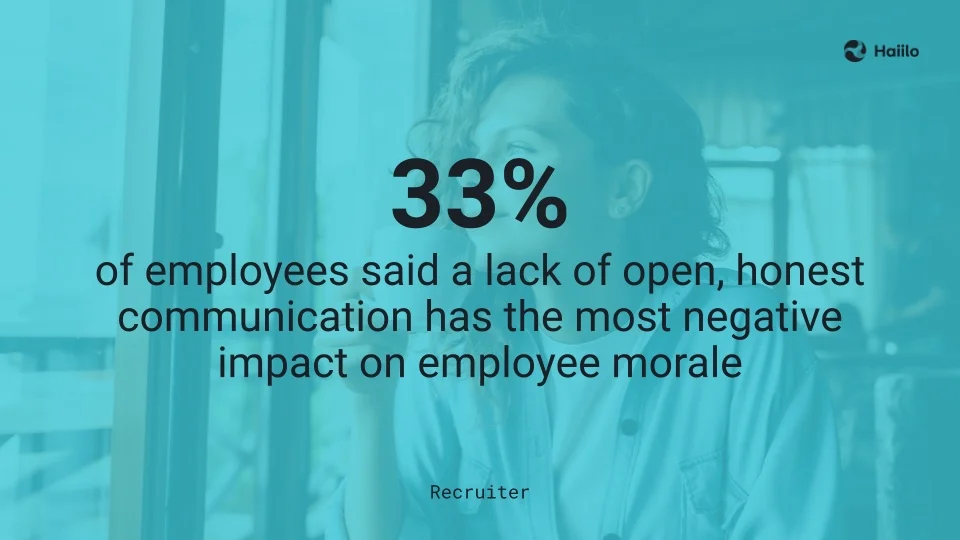
In general, the sense of teamwork has a strong influence on employee experience, happiness, and overall levels of job satisfaction and employee motivation. When people feel connected to their team, they are more likely to stay engaged, contribute ideas, and take ownership of outcomes.
To support this, make sure your teams are truly functional. High‑performing teams don’t rely on ad‑hoc updates or informal knowledge alone. They need the means to communicate efficiently and stay connected, regardless of where team members are located or how they work. Strong teamwork communication helps reduce friction, clarify priorities, and keep everyone aligned around shared goals.
5. More knowledge sharing and innovation
Good workplace communication plays a critical role in enabling knowledge sharing across teams. Today, teams can’t work in silos anymore. Modern work depends on collaboration across roles and departments, which means employees must continuously share insights, lessons learned, and expertise.
This requires open channels for discussion and the ability to provide frequent employee feedback in a timely and constructive way. When teamwork communication is effective, information flows more freely and teams are better equipped to learn from one another.
Knowledge workers are only as valuable as their ability to share what they know. For that to happen, team communication needs to be clear, accessible, and consistent. Without shared understanding, even the best ideas remain isolated.
One of the most valuable outcomes of strong knowledge sharing is innovation. When information moves easily through a workplace, it becomes much easier to acquire new knowledge, challenge assumptions, and develop relevant ideas or improvements. Teams that communicate well are more likely to experiment, adapt, and turn insights into action.
Learn about how to enable knowledge workers for success!
Making Team Communication More Efficient With the Right Technology
Working from home and hybrid work require organisations to build modern digital workplaces and adapt to new technologies that support how employees communicate and collaborate. When teams no longer share the same physical space, technology becomes the foundation for effective teamwork communication.
Over the past few years, collaboration tools have moved from being “nice to have” to essential. Most employees now rely on digital tools to coordinate tasks, share updates, and stay connected with their teams. This shift has fundamentally changed how teamwork communication happens on a daily basis.
However, simply adding more tools does not automatically improve collaboration. While demand for hybrid work continues to grow, organisations must be intentional about how they design their communication ecosystem. Poorly implemented tools, overlapping platforms, or unclear usage guidelines can quickly lead to overload and fatigue.
For teamwork communication to truly improve, teams need the right balance. Fewer, well‑integrated tools with clear purposes help reduce frustration and keep communication focused. When collaboration technology is chosen and used thoughtfully, teams can work more flexibly, feel more confident in their roles, and collaborate effectively across time zones and locations.
The goal is not more communication, but better communication. With the right technology in place, teams can create shared understanding, support asynchronous work, and maintain strong collaboration—regardless of how or where they work.

Another survey showed that most professionals rely heavily on technology to collaborate and stay connected. This dependence highlights how central digital tools have become to everyday teamwork communication. When these tools fail or are removed, collaboration slows down and teams struggle to stay aligned.
At the same time, many employees experience real challenges when using collaboration tools. Common issues include information overload, poor usability, unclear ownership of channels, and constant switching between platforms. When tools add friction instead of clarity, teamwork communication becomes harder, not easier.
This is why technology is reshaping teamwork as we know it. Organisations need to understand their workforce before selecting or rolling out new communication tools. Choosing technology without considering how people actually work often leads to low adoption and frustration.
It is essential to understand the nature of your employees’ work, as well as generational and cultural differences. Some teams work asynchronously, others collaborate in real time. Some employees are desk-based, while others are deskless or mobile. The technology must be mobile-first, intuitive, yet flexible enough to scale as your organisation grows.
Another critical factor when choosing an internal communications platform is integration. Make sure the software connects smoothly with your existing tools, including social and communications channels, as well as other systems in your tech stack. Seamless integration reduces context switching and supports more consistent teamwork communication.
Modern employee communications solutions provide the features and capabilities needed to enable your employees to collaborate and communicate more efficiently. The right platform removes barriers, improves clarity, and supports both synchronous and asynchronous work.
Some of the must-have features to look for include:
- Robust audience segmentation that enables targeted communications based on employees’ job functions, locations, languages, and interests
- Private and public channels for focused collaboration and open discussion
- Meeting recordings to support asynchronous teamwork communication
- Document sharing functionalities to boost collaboration
- Organised knowledge hubs to ensure everyone has the right information
- Mobile-first interface for the best digital employee experience
- Active directory integration for seamless user access and management
- Easy-to-use surveys and polls for continuous employee feedback
- Push notifications for urgent updates and insights into message readership
- Seamless integrations with intranets, messaging apps, file-sharing tools, and other internal systems
- ISO and GDPR certifications to protect your organisation’s data
- Advanced AI-powered analytics with actionable recommendations to improve workplace communication efforts
If you are looking for the right technology to optimise asynchronous workflows and strengthen teamwork communication, schedule a Haiilo demo!
FAQs: teamwork communication
What is teamwork communication, and why does it matter today?
Teamwork communication is how people share information, align on goals, and solve problems together as a group. It matters more than ever because teams are often hybrid, remote, or distributed across time zones. Without clear teamwork communication, misunderstandings grow, work slows down, and motivation drops. Strong communication helps teams stay aligned, make better decisions, and feel connected—even when they don’t work in the same place.
What are the most common challenges teams face with communication?
Many teams struggle with information overload, unclear expectations, and messages scattered across too many tools. In remote and hybrid settings, these issues are amplified. Teams may also face hidden communication barriers, such as assumptions, silos, or lack of feedback loops. Understanding these challenges is the first step to improving teamwork communication and building habits that support clarity and trust.
How can teams improve communication without adding more meetings?
Better teamwork communication doesn’t mean more meetings—it means clearer processes. Practices like asynchronous communication help teams share updates and decisions without constant real-time calls. Clear documentation, shared channels, and agreed response times all reduce interruptions. Supporting teams with the right internal communication approach makes it easier to collaborate effectively while respecting focus and flexibility.
What tools support better teamwork communication in modern workplaces?
The best tools support two-way communication, not just announcements. Platforms built for employee communications and internal communication help teams share updates, collaborate transparently, and stay aligned. A social intranet can also play a key role by giving teams a central place to connect, find information, and share knowledge. When communication tools are designed around how people actually work, teamwork communication becomes more natural and consistent.
Find
your
flow
Bring communication, knowledge, and tools into one calm place — and help your people find their flow.