
7 Internal Communications Trends to Consider in 2024



Keeping pace with internal communications trends has never been more important — or more challenging.
As we move into 2027, the role of internal communications has shifted from a support function to something far more critical: a driver of employee experience, alignment, and business performance. In today’s hybrid, AI-powered workplace, communication is no longer just about sending messages. It’s about creating clarity, reducing friction, and helping people do their best work.
What’s becoming clear across the latest internal communications trends is that how organizations communicate is now just as important as what they communicate. Employees aren’t just evaluating the message — they’re judging the experience around it: how easy it is to find, how relevant it feels, and whether it actually helps them move forward. When communication fails, it’s not seen as an inconvenience. It’s seen as a barrier to getting work done.
And the scale of that problem is bigger than many organizations realize. Studies show employees can lose more than 35 working days per year due to ineffective communication, driven by unclear messaging, unnecessary meetings, and time spent searching for information. At the same time, employees spend a significant portion of their workweek simply trying to interpret and respond to messages — in fact, as much as 88% of the workweek is now tied to communication activities in some form. That’s a huge amount of effort spent not doing the work itself, but navigating how work gets communicated.
The stakes are high. Research shows that poor communication still wastes significant time and productivity, with employees losing dozens of working days each year due to unclear messaging and information gaps. At the same time, global engagement remains stubbornly low — hovering around 21–23% in recent data — highlighting a widening gap between what organizations say and what employees actually experience.
So, what does that mean for internal communicators?
It means the old playbook no longer works.
Broadcast emails, scattered tools, and one-size-fits-all messaging simply can’t keep up with the complexity of modern work. Employees now expect the same level of personalization, relevance, and ease they get in their everyday digital lives — and they’re quick to disengage when communication falls short.
At the same time, the environment around us is evolving fast:
- Hybrid work is now the default, not a perk, changing how and where communication happens
- AI is rapidly becoming embedded in workflows, helping teams create, analyze, and optimize communication at scale
- Employee expectations are rising, with demand for transparency, purpose, and connection at an all-time high
- Information overload is increasing, making clarity and relevance more valuable than ever
In this context, internal communications is no longer about volume. It’s about precision.It’s about delivering the right message, to the right people, at the right time — in a way that actually makes work easier.💡Read: The weird future of internal commsTable of contents
- 1. The Rise of Employee Experience Platforms
- 2. Emphasis on Mobile Accessibility
- 3. The Integration of AI in Internal Communications
- 4. Focus on Mental Health and Wellbeing
- 5. Increased Use of Video Content
- 6. The Importance of Measurement and Analytics
- 7. Personalization of Content in Internal Communications
- What Next?
Haiilo keeps your employees connected while improving company culture and giving you the tools you need to measure success.
1. The rise of employee experience platforms
Employee experience platforms are rapidly becoming the norm for businesses seeking to streamline their communication efforts while enhancing overall employee engagement. But as one of the defining internal communications trends, their role goes beyond consolidation — they’re fundamentally changing how communication is planned, delivered, and measured.
In the past, internal communications often sat across multiple owners: HR, IT, and comms teams each managing their own channels, tools, and priorities. The result was inconsistent messaging and a lack of visibility into what was actually working. Employee experience platforms change that dynamic by creating a shared system of record — one place where communication is orchestrated, tracked, and continuously improved. This shift from “sending updates” to managing communication as a system is a major step forward for internal comms maturity.
These platforms are also raising the bar for what “good” internal communication looks like. It’s no longer enough to measure success by open rates or clicks. Instead, teams are starting to focus on outcomes: Did employees understand the message? Did it change behaviour? Did it reduce confusion or support better decision-making? This is where employee experience platforms stand out — they bring in analytics, feedback loops, and engagement data that help communicators connect their work to real business impact.
They’re also reshaping the role of internal communicators themselves. Rather than acting as content producers or channel owners, teams are increasingly operating as experience designers — thinking about journeys, touchpoints, and timing. That might mean mapping how a new joiner experiences communication in their first 90 days, or how a frontline employee accesses critical updates without being tied to email. It’s a more strategic, more intentional approach — and it’s quickly becoming the standard as internal communications trends evolve.
A prime example of such a tool is Haiilo’s employee experience platform, which brings together communication, knowledge, learning, and insights into one connected experience. Instead of treating communication as a series of disconnected campaigns, it enables organizations to build a consistent, measurable experience that evolves over time.
The business case for this shift is hard to ignore. Poor communication and teamwork are still cited by 86% of employees and managers as a primary cause of workplace issues, reinforcing the need for a more structured, strategic approach. At the same time, organizations that improve communication see tangible gains in productivity, engagement, and retention — showing that this isn’t just a comms upgrade, but a business performance lever.
As internal communications trends continue to evolve, employee experience platforms are becoming the backbone of modern workplace communication — not because they add more channels, but because they make communication more intentional, measurable, and aligned with how work actually happens.
Organizations that embrace this approach benefit from:
- More strategic, data-driven communication planning
- Clearer links between communication and business outcomes
- Better visibility into what’s working (and what isn’t)
- A more consistent and cohesive employee experience
Ultimately, employee experience platforms signal a shift from communication as an activity to communication as a capability — something organizations can design, optimize, and continuously improve over time.
💡Read: The Digital Workplace Problem Report
2. Emphasis on mobile accessibility
The shift toward mobile-first communication strategies marks one of the most visible internal communications trends in today’s workplace. It reflects a fundamental change in how work actually happens day to day. As hybrid and remote models become the norm, employees are no longer tied to desks, offices, or even fixed schedules — which means communication has to be built around movement, not location.
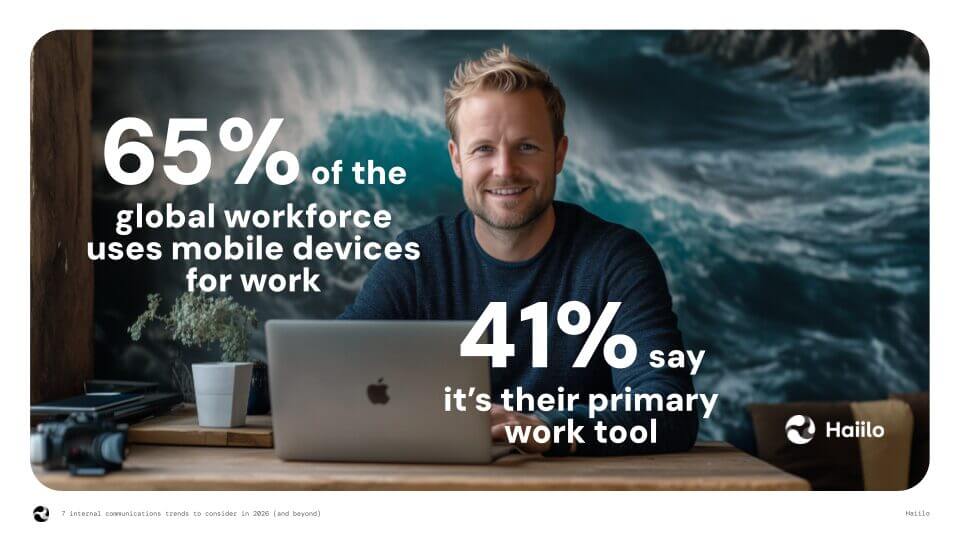
What’s changed isn’t just where people work, but the primary device they rely on. Today, 65% of the global workforce uses mobile devices for work, and 41% say it’s their primary work tool. That’s a major shift — and one that forces internal communications to rethink the default channel. Desktop-first intranets and long email updates simply don’t match how most employees now access information.
This becomes even more important when you consider who’s being left out. Around 70–80% of the global workforce is deskless — working in roles where traditional communication channels don’t reach them effectively. Many frontline employees don’t have regular access to corporate email, and only a small proportion have consistent access to desktop systems. For these teams, mobile isn’t a convenience — it’s the only realistic way to stay connected.
As a result, mobile accessibility is becoming a matter of inclusion, not just convenience. One of the key internal communications trends is the shift toward “communication equity” — ensuring that every employee, regardless of role or location, has equal access to timely, relevant information. If communication only reaches desk-based employees easily, it creates a structural gap that impacts engagement, safety, and performance.
Mobile is also reshaping expectations around speed and responsiveness. Employees increasingly expect updates to be delivered in real time, in formats that are easy to digest on the go. Smartphones are already deeply embedded in the workday, with over 80% of employees using them for work-related activities and relying on them for messaging, updates, and coordination. That immediacy raises the bar — communication is no longer something employees “catch up on,” it’s something they experience as part of the flow of work.
Mobile is now the default communication channel
What’s changing isn’t just access — it’s behavior:
- Short, scannable content is prioritized over long-form updates
- Push-based communication replaces passive channels like email
- Updates are expected to be timely, contextual, and easy to act on
This shift is less about technology and more about attention. Mobile forces communicators to be clearer, faster, and more deliberate with every message — because employees are often engaging in short bursts, between tasks, or on the move.
Designing for mobile means designing for real-world use
Mobile accessibility isn’t just about shrinking content onto a smaller screen. It’s about adapting communication to how people actually consume information in the moment. That means recognizing that employees may only have seconds — not minutes — to read an update, and designing accordingly.
Leading organizations are starting to treat mobile as the primary experience, not a secondary one. That includes:
- Concise formats that prioritize clarity over detail
- Action-oriented messaging that helps employees immediately understand what to do next
- Context-aware delivery that matches content to role, location, and timing
What this means for internal communications
For internal communicators, the takeaway is straightforward: if communication isn’t built for mobile, it risks missing a large portion of the workforce entirely.
A mobile-first approach helps:
- Reach employees in real time, regardless of location or role
- Ensure frontline teams are as informed as office-based staff
- Deliver updates in a format that matches how people actually work
- Create a more inclusive and accessible communication experience
Ultimately, this trend is less about devices and more about access. Mobile accessibility ensures that communication isn’t limited by role, location, or schedule — which is essential if internal communications is going to deliver on its core goal: keeping everyone aligned, informed, and able to act.
These mobile platforms offer several advantages. They allow for real-time updates and instant access to critical information, ensuring employees are always in the loop. This immediacy is crucial in maintaining continuity and coherence in an increasingly dispersed work environment. Additionally, mobile platforms often have features that promote interaction and collaboration among team members, breaking down barriers that physical distances might create.
The effectiveness of mobile-first strategies is also evident in the realm of employee engagement. These platforms facilitate more than just top-down communication; they encourage a two-way dialogue – employees can provide feedback, engage in discussions, and contribute to the organizational community, all from their mobile devices. This level of engagement is vital in building a strong company culture and ensuring that employees feel valued and heard.
The impact of mobile accessibility on internal communications cannot be overstated. It is a trend that aligns with the needs of a modern workforce and the realities of today’s work environments. As organizations continue to adapt to these changing dynamics, the emphasis on mobile accessibility is likely to grow, further showing its importance in effective internal communication.
🧐 Learn More: Top 10 employee communications platforms
3. The integration of AI in internal communications
Artificial intelligence (AI) is quickly becoming one of the most transformative internal communications trends — not just because of what it can do, but because of how it changes the role of communication itself. This isn’t simply about automating tasks. It’s about shifting internal comms from a manual, time-heavy function into something faster, more adaptive, and far more scalable.
One of the most immediate impacts of AI in internal communications is in content creation. Writing updates, summarizing long documents, adapting tone for different audiences — all of these traditionally time-consuming tasks can now be accelerated significantly. Teams using generative AI are already reporting meaningful efficiency gains, with some seeing double-digit time savings on routine communication tasks. This frees internal communicators up to focus less on producing content, and more on shaping strategy and improving outcomes.
At the same time, AI is helping tackle a core challenge in modern communication: scale. As organizations grow and diversify, creating relevant content for different roles, regions, and needs becomes increasingly difficult. AI addresses this by making personalization achievable at scale — not as a manual effort, but as a built-in capability. By analyzing behaviour and interaction patterns, AI can help tailor communication so that employees receive content that’s more relevant to them, without adding extra workload for comms teams.
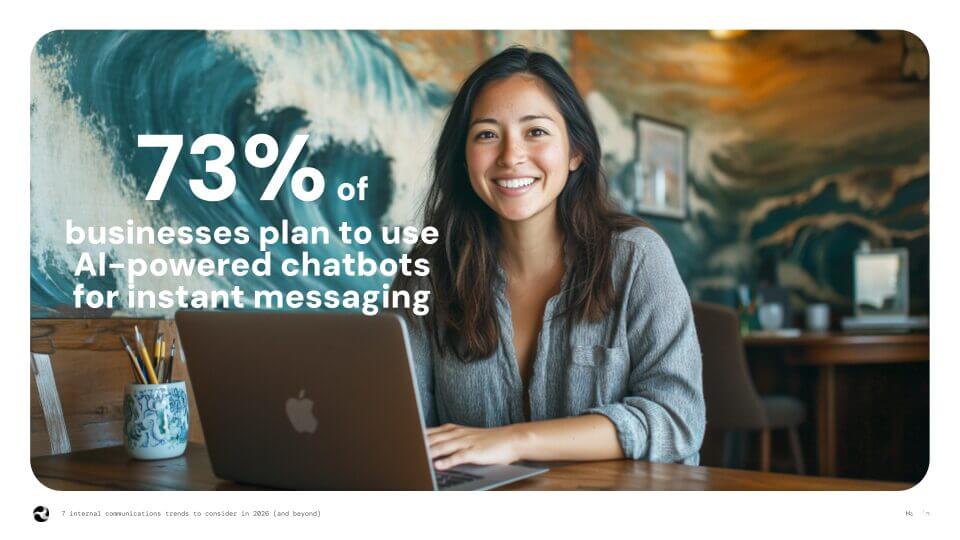
Another major shift is the rise of AI-powered assistants — including chatbots and embedded copilots — that sit directly within the flow of work. These tools allow employees to quickly find answers, surface information, or complete simple tasks without needing to search through multiple systems or wait for responses. This matters because time lost to searching for information remains a significant issue in many organizations, slowing productivity and increasing frustration. AI reduces that friction by making knowledge instantly accessible.
Beyond day-to-day execution, AI is also starting to influence how communication is planned. One of the more advanced internal communications trends is the move toward predictive and data-informed strategies. Instead of reacting to issues after they arise, teams can use AI to identify patterns in engagement, sentiment, and behaviour — helping them anticipate where communication gaps might appear and address them proactively.
💡Download: The 2026 guide to AI in internal comms
This is particularly valuable in complex, fast-moving environments where timing is critical. Knowing when to communicate, which channel to use, and how to frame a message can have a significant impact on whether it lands. AI-driven insights help remove some of that guesswork, allowing communicators to make more informed decisions based on real data rather than assumptions.
Importantly, this doesn’t replace the human side of communication — it amplifies it. Trust, clarity, and context still depend on people. But AI acts as a force multiplier, helping teams deliver those qualities more consistently, and with far less manual effort.
As adoption continues to grow, AI is moving from an experimental tool to a core part of the internal communications toolkit. In fact, a growing majority of workers expect AI to shape how communication works in the future, with 68% believing it will significantly impact the communication sector in the coming years.
For internal communicators, the implication is clear: AI isn’t just another trend to watch — it’s becoming a baseline capability. Teams that embrace it can operate faster, communicate more effectively, and focus on higher-value work. Those that don’t risk being slowed down by manual processes in an environment that’s only getting more complex.
Ultimately, AI is helping internal communications evolve from a reactive function into a more intelligent, proactive one — where communication is not only faster and more efficient, but also more relevant, timely, and impactful.
🤖 Read: Top 5 ways AI can be used to embrace internal communications
4. Focus on mental health and wellbeing
Recognizing the impact of mental health on overall employee performance and satisfaction, organizations are increasingly weaving wellbeing into the fabric of their communication strategies. As one of the more human-centric internal communications trends, this shift reflects a broader realization: how you communicate can be just as important for wellbeing as what you communicate.
In high-pressure, always-on work environments, communication itself can either reduce stress or add to it. Poorly timed updates, unclear expectations, or constant messaging can contribute to overwhelm — while clear, empathetic, and well-paced communication can help employees feel more in control of their work. With 41% of employees reporting daily stress globally, it’s clear that organizations can’t afford to treat communication as neutral — it actively shapes how people feel day to day.
This is why wellbeing is becoming a core part of internal communications trends, not a separate initiative. It’s showing up in how messages are written, how often they’re sent, and how leaders communicate with their teams. Tone matters more. Clarity matters more. And context matters more. Employees don’t just want information — they want communication that feels considered, respectful of their time, and genuinely supportive.
💡Download: The 2026 guide to building good culture
One practical way organizations are responding is by using internal communication channels to normalize conversations around mental health. Regular updates that highlight available support, share practical advice on managing workload, or reinforce the importance of taking breaks all contribute to building a healthier culture. These communications signal that wellbeing isn’t an afterthought — it’s something the organization takes seriously and talks about openly.
At the same time, companies are using communication platforms to create space for connection. Community groups, peer discussions, and informal channels allow employees to share experiences and support one another — which is especially important in hybrid and remote environments where isolation can become a real challenge. Research shows that a significant proportion of employees experience stress and disconnection at work, and creating spaces for dialogue can help close that gap.
Listening is another critical piece. Tools like internal surveys and pulse checks give organizations real insight into how employees are feeling — not just about their workload, but about communication itself. Are messages clear? Is there too much noise? Do employees feel informed or overwhelmed? These insights allow teams to adjust communication strategies in ways that genuinely support wellbeing, rather than unintentionally contributing to stress.
There’s also a growing recognition that communication plays a direct role in trust. Employees who feel informed, heard, and supported are far more likely to feel connected to their organization. And that connection has real business impact — from engagement and retention through to performance. In other words, wellbeing isn’t just a cultural priority; it’s a performance driver.
As internal communications trends continue to evolve, the focus on mental health and wellbeing signals a clear shift in mindset. Communication is no longer just about alignment and efficiency — it’s about creating an environment where people can do their best work without burning out.
Ultimately, organizations that get this right aren’t just sharing information more effectively. They’re creating a communication experience that feels calmer, clearer, and more human — and that’s what employees increasingly expect.
🤝 Keep employees connected: Understanding different types of internal communication
5. Increased use of video content
From internal announcements to training sessions, video content is rapidly becoming a core part of how organizations communicate. But this isn’t just about format — it reflects a deeper shift in internal communications trends toward more human, visible, and accessible communication.
One of the biggest reasons for this shift is simple: video reduces distance. In hybrid and distributed organizations, employees don’t always have direct access to leaders or face-to-face moments with their teams. Video helps bridge that gap. A short leadership update, a recorded message, or even a quick explainer can create a sense of presence that written communication struggles to replicate. It adds tone, context, and personality — all of which are critical for building trust.
This is particularly important at a time when clarity and alignment are harder to maintain. Research shows that communication has a direct impact on how well employees understand organizational goals, with 79% of employees saying the quality of communication they receive affects their understanding of company priorities. Video can play a key role here by making messages clearer, more direct, and easier to absorb — especially when explaining complex updates or strategic changes.
🚀 Boost engagement: 9 steps to creating more engaging internal content
Another reason video is gaining traction is how it fits into modern content habits. Employees are used to consuming information quickly, often in short bursts, and video aligns naturally with that behaviour. Instead of reading through long documents or dense emails, employees can watch a concise update that delivers the key message in seconds. This is especially valuable in environments where attention is limited and time is fragmented.
Importantly, video doesn’t just improve understanding — it also improves consistency. When a message is delivered through video, every employee receives the same tone, emphasis, and context. There’s less room for misinterpretation, and fewer gaps between what’s said and what’s understood. That consistency becomes increasingly valuable as organizations scale or operate across multiple regions and teams.
At the same time, advances in tools and platforms have made video far more accessible. Creating and sharing video content no longer requires specialist skills or large budgets. Simple editing tools, templates, and built-in platform features mean that teams across the organization — not just comms or marketing — can contribute. As a result, video is becoming less of a “campaign tool” and more of an everyday communication format.
There’s also a cultural shift happening. Video makes communication feel more open and less formal, which can encourage greater engagement. Employees are more likely to feel connected when they can see and hear the people behind the message, rather than just reading static text. This is particularly valuable for reinforcing company culture, celebrating success, and creating a stronger sense of belonging.
As internal communications trends continue to evolve, the rise of video content points to a clear direction: communication is becoming more visual, more immediate, and more human. Organizations that adapt to this shift are better equipped to cut through the noise, build trust, and ensure their messages actually land.
Ultimately, video isn’t just an add-on to existing channels — it’s becoming a primary way of communicating. And in a workplace where attention is limited and connection matters more than ever, that makes it an increasingly indispensable part of the internal communications toolkit.
💡Download: The Haiilo guide to flow in the workplace
6. The importance of measurement and analytics
Tracking the effectiveness of communication strategies is no longer just about reporting on performance — it’s becoming a core part of how internal communications earns credibility and influence within the business. As one of the most important internal communications trends, measurement is shifting the function from perceived “support role” to something far more strategic and accountable.
Historically, many internal comms teams relied on basic metrics like open rates or intranet visits to gauge success. While these still provide useful signals, they only tell part of the story. The real shift happening now is toward measuring impact, not just activity. That means asking deeper questions: Did the message change behaviour? Did it improve understanding? Did it reduce confusion or drive action?
This matters because communication is increasingly tied to business outcomes. Research shows that effective communication directly influences productivity, engagement, and alignment — with teams that communicate well able to see up to 25% higher productivity. Without measurement, it’s difficult to demonstrate that impact or justify further investment.
Analytics also play a key role in decision-making. Internal communicators are no longer just publishing content — they’re continuously optimizing it. Data helps answer critical questions such as which channels perform best, what content resonates with different audiences, and when employees are most likely to engage. Over time, this creates a feedback loop where communication becomes more targeted, more relevant, and more effective with every iteration.
Another important development within internal communications trends is the combination of quantitative and qualitative insight. Metrics like clicks and views provide a clear picture of reach and engagement, but they don’t always explain why something worked — or didn’t. That’s where employee feedback becomes essential. Surveys, pulse checks, and direct feedback help add context to the numbers, giving a more complete view of how communication is experienced across the organization.
There’s also a growing expectation from leadership for communication to be measurable in the same way as other business functions. Marketing, sales, and product teams all operate with clear performance data — and internal communications is being held to the same standard. This shift is pushing teams to adopt more advanced analytics tools and frameworks that link communication directly to outcomes like engagement, retention, and performance.
💡Download: How internal comms can secure more budget
Ultimately, measurement is what enables internal communications to move from intuition to evidence. Instead of relying on assumptions about what works, teams can make informed decisions backed by real data — and clearly demonstrate the value of their work to the wider organization.
As internal communications trends continue to evolve, measurement and analytics are becoming non-negotiable. Not just because they improve communication, but because they prove its impact. And in an environment where every function is expected to show value, that makes measurement one of the most powerful tools internal communicators have.
➡️ Keep reading: Unveiling the power of metrics in your communications strategy
7. Personalization of content in internal communications
Hyper-personalization, often described as the “Internet of Me,” is quickly becoming one of the most defining internal communications trends — not because it’s new, but because it’s now expected. Employees are used to personalized digital experiences in their everyday lives, from streaming platforms to social media feeds. They’re increasingly expecting the same relevance and precision from workplace communication.
This shift raises the stakes for internal communicators. Generic, one-size-fits-all messaging no longer stands out — in fact, it’s more likely to be ignored. Personalization, in this context, isn’t about making communication feel “nice to have.” It’s about making it worth paying attention to in an already crowded information environment. When every message competes for attention, relevance becomes the deciding factor.
This trend goes far beyond surface-level personalization like adding someone’s name to an email. It’s about using data and behavior analysis to shape what employees see, when they see it, and how it’s delivered. That could mean prioritizing role-relevant updates in an intranet feed, tailoring learning content to individual development goals, or surfacing information based on location, function, or past interactions.
The impact of this level of personalization is significant. When communication feels directly relevant, employees are more likely to engage with it — and more importantly, act on it. There’s a clear link between communication quality and employee understanding, with studies showing that the clarity and relevance of communication directly influence how well employees grasp organizational goals. Personalization plays a key role in achieving that clarity.
It also changes how employees perceive the organization. Receiving targeted, relevant information creates a stronger sense that the organization understands their role and priorities. That feeling — of being seen, rather than broadcast to — can have a noticeable effect on engagement and connection. In contrast, irrelevant or overly broad messaging can quickly lead to disengagement, especially in larger or more complex organisations.
From an operational perspective, personalization is becoming more achievable thanks to advances in analytics and AI. Organizations can now harness insights from employee behaviour to continuously refine communication strategies. Instead of guessing what different audiences need, communicators can rely on real data to guide decisions — making personalization more scalable and less resource-intensive.
Of course, this shift also introduces new challenges. Organizations need to strike the right balance between relevance and privacy, ensuring that data is used responsibly and transparently. At the same time, personalization must be designed inclusively — making sure important information still reaches everyone, not just specific segments.
As internal communications trends continue to evolve, personalization is moving from a competitive advantage to a baseline expectation. Employees don’t just want information — they want information that feels tailored, timely, and useful to them as individuals.
Ultimately, the goal of personalization isn’t to send more communication. It’s to send less — but make every message count.
🔎 Explore: 9 ways to help employees find purpose at work
What next?
The internal communications trends shaping 2026 all point in the same direction: communication is becoming more intentional, more data-driven, and more closely tied to real business outcomes. What was once seen as a support function is now firmly positioned as a strategic capability — one that directly influences alignment, engagement, and performance across the organization.
But recognising these internal communications trends is only the first step. The real challenge — and opportunity — lies in how organizations respond. Because while the tools, channels, and expectations have evolved, many teams are still operating with outdated approaches that can’t keep up with the pace and complexity of modern work.
The gap between intent and execution is still significant. Employees continue to struggle with unclear messaging, disconnected experiences, and inconsistent access to information — all of which impact productivity and engagement. In fact, ineffective communication can still cost employees dozens of working days each year in lost time and confusion. At the same time, global engagement levels remain low, reinforcing the need for communication that is not just frequent, but meaningful and actionable.
So, what does moving forward actually look like?
It means shifting away from volume and toward impact. From sending more messages to making every message clearer, more relevant, and easier to act on. From managing channels to designing experiences that support how people actually work.
For internal communication professionals, this marks a clear evolution in role:
- From content producers to experience designers
- From message owners to strategic partners
- From measuring outputs to demonstrating impact
And for organizations, it requires a more joined-up approach — where communication is integrated with employee experience, leadership, and business strategy, rather than operating in isolation.
Technology will continue to play a major role here, but it’s not the starting point. The most successful organizations won’t be the ones with the most tools — they’ll be the ones that use them with purpose, aligning communication to what employees actually need to do their jobs effectively.
That said, having the right infrastructure in place makes this shift far more achievable. Platforms that bring together communication, insights, and employee experience can help organizations move faster, reduce friction, and deliver more consistent, measurable outcomes.
Ultimately, the next phase of internal communications isn’t about keeping up with trends — it’s about turning them into tangible improvements in how work feels day to day.
Because when communication works:
- Employees understand what’s expected of them
- Teams stay aligned and focused
- Organizations move faster, with less friction
And that’s the real goal — not just better communication, but better work.
Here’s to a more connected, more effective, and far less frustrating workplace in 2026 and beyond.
FAQs: internal communications trends
What are the most important internal communications trends right now?
The most important internal communications trends include the rise of employee experience platforms, mobile-first communication, AI-powered tools, personalization, video content, and a stronger focus on measurement and wellbeing. Together, these trends reflect a shift toward communication that is more targeted, data-driven, and aligned with how people actually work.
Why are internal communications trends changing so quickly?
Work itself has changed. Hybrid and remote models, rising employee expectations, and increasing digital complexity have all reshaped what effective communication looks like. Employees now expect clarity, relevance, and ease — not just more messages. As a result, internal communications is evolving from a broadcast function into a strategic driver of engagement and performance.
How can internal communicators keep up with these trends?
The key is to focus on outcomes, not just channels. That means prioritising clarity over volume, designing communication for specific audiences, and using data to continuously improve. Staying close to employee needs — through feedback and analytics — is far more valuable than chasing every new tool or trend.
What role does technology play in modern internal communications?
Technology is an enabler, not the solution itself. Platforms, AI, and analytics tools help teams work faster and smarter, but they only deliver value when used intentionally. The most effective organisations use technology to simplify communication, not complicate it.
Are these trends relevant for all organisations?
Yes — but how they’re applied will vary. A global enterprise and a mid-sized business may use different tools or approaches, but the underlying principles remain the same: communication should be clear, accessible, relevant, and measurable.
What’s the biggest mistake organisations make with internal communications?
Focusing on output instead of impact. Sending more emails, more updates, or more campaigns doesn’t guarantee better communication. The real goal is to help employees understand, align, and act — everything else is secondary.
Find
your
flow
Bring communication, knowledge, and tools into one calm place — and help your people find their flow.