
7 internal communication trends that will define 2027



Remember when internal communication was mostly newsletters, leadership updates, town halls, and the occasional campaign asking people not to click suspicious links?
Those days were not necessarily better. They were definitely simpler.
Now, employees receive summaries of meetings they did not attend, messages personalized by algorithms they cannot see, videos that may feature a synthetic version of a real leader, and enough notifications to make “keeping everyone informed” feel like a minor threat.
AI use is already mainstream in the profession. A 2026 Ragan survey reported that only 22% of respondents were not using AI at work. 75% were using generative AI to draft or edit content, 47% for meeting notes or interview transcription, and 25% for sentiment analysis.
At the same time, trust is under pressure. Edelman’s 2026 Trust at Work study found that trust in employers remained relatively high at 74%, but had fallen five points since August 2024. Three in four employees had experienced at least one major workplace transformation in the previous year.
That is the context for 2027: more change, more synthetic content, and less patience for messages that feel vague, irrelevant, or suspiciously polished.
Here are the internal communication trends that matter most.
1. Every message faces an AI authenticity audit
Employees will increasingly ask a simple question: did a person actually mean this?
AI-assisted writing is not automatically inauthentic. It can help communicators draft, summarize, translate, and adapt content. The problem begins when the finished message has no sign of human judgment, no concrete detail, and no recognizable voice.
🔎Read: How to Make AI Really Boring (& Why That’s a Good Thing)
In 2027, communicators will develop clearer disclosure norms. Some content may be labeled human-written, AI-assisted, or human-reviewed. More importantly, teams will know when authenticity matters enough to keep AI backstage.
A policy reminder can be drafted quickly. A message about layoffs, safety, grief, or major change needs visible human ownership.
💡 The shift: Authenticity beats polish.
2. Synthetic leadership becomes normal, with consent
Executive avatars and voice replicas will make it easier to localize updates across languages, time zones, and formats. Used transparently, this will expand access and awareness. Used carelessly, it can make leaders feel like a haunted screensaver.
The trust test is not whether synthetic media exists. It is whether employees know what they are seeing, why it was used, and who approved the message.
🔎Read: The 2026 Guide to Good Internal Comms
Communicators will need rules covering disclosure, consent, security, sensitive topics, localization, and the point at which a real leader needs to show up as a real leader.
💡 The shift: Scalable presence requires unmistakable accountability.
3. Accidental influencers become essential channels
The most trusted explainer in the organization may be an engineer, nurse, store manager, analyst, or customer service specialist who has never attended a communication planning meeting and would prefer to keep it that way.
These employees earn attention because they are useful, specific, and credible. Internal communicators will increasingly identify expert voices, help them share knowledge, and connect them with the right audiences.
🔎Read: 5 Weird Employee Advocacy Trends for 2027
This is not about coaching employees into becoming corporate mascots. It is about making real expertise more visible.
💡 The shift: Trust follows people who know what they are talking about.
4. Listening moves from quarterly to continuous
Annual surveys and quarterly pulses will still matter, but they are too slow to capture fast-moving confusion.
Communication teams will use a wider mix of signals: questions, search behavior, comments, community themes, help requests, manager feedback, event responses, and carefully governed sentiment analysis. The purpose should be to understand emerging needs, not to monitor individual employees.
The distinction matters. Listening builds trust only when employees understand how data is used and see evidence that somebody acted on it.
💡 The shift: The grapevine gets a dashboard.
5. Communication debt becomes measurable
Every unanswered question creates more work later.
When employees repeatedly ask what a strategy means, how a policy applies, or why a change happened, the organization accumulates “communication debt”. Teams respond by publishing more reminders, while the underlying gap remains untouched.
In 2027, mature communication functions will track recurring confusion, outdated content, unresolved questions, missing context, and unsupported managers. They will prioritize the debt that creates the most friction or risk.
💡 The shift: Success includes the questions employees no longer need to ask.
6. Radical context replaces performative transparency
Employees rarely expect access to every confidential detail. They do expect leaders to explain the logic behind decisions that affect their work.
That means sharing tradeoffs, constraints, uncertainty, rejected options, and what happens next. Edelman’s 2026 Trust Barometer found that change can strengthen trust when employees have clarity, room to adapt, and opportunities to grow. Communication becomes more credible when it treats employees like adults who can cope with reality.
“This was a difficult decision” is not context. It is the corporate equivalent of a weather icon.
💡 The shift: Explain how the decision was made, not only that it was made.
7. Search becomes a primary communication channel
Employees will not always see an update when it’s published. They will find it when they need an answer.
That changes content strategy. A strong message must also be easy to retrieve later. Headlines, summaries, metadata, ownership, structure, and freshness become part of communication quality. Communicators will write for feeds, search engines, and AI assistants at the same time.
The new question is not only “Did people read it?” It is “Could the right person find and trust it three months later?”
💡 The shift: Findability becomes a form of engagement.
What internal communicators should do now
The trends may sound futuristic, but the preparation is wonderfully practical:
1. Create clear rules for AI-assisted and synthetic communication.
2. Define which channels are urgent, durable, conversational, or personalized.
3. Build a network of trusted employee experts and local voices.
4. Turn recurring questions into owned, searchable knowledge.
5. Give managers context before employees receive the announcement.
6. Measure understanding and action, not only exposure.
7. Delete at least one phrase containing “leveraging.” You will feel lighter.
Clear, trusted, and easy to find
The internal communication teams that succeed in 2027 will not be the teams that publish the most. They will be the teams that help employees understand what is happening, why it matters, and what to do next.
Haiilo helps communicators manage channels, target audiences, translate and adapt content, gather feedback, and measure impact from one employee experience platform. It also helps connect communication to the knowledge employees need after the launch moment has passed.
Because reach matters. Relevance matters more. And trust is the bit holding everything together.
Explore Haiilo employee communications or book a demo.
FAQs on 2027 internal comms trends
AI-assisted creation, synthetic media, personalization, continuous listening, employee experts, enterprise search, plain language, and trust-centered measurement will shape internal communications in 2027.
Use AI for drafting, summarizing, translating, and repurposing, but keep human accountability. Add specific context, disclose synthetic media, define sensitive topics that require direct human communication, and review every important message for truth, tone, and usefulness.
Measure reach alongside understanding, confidence, action, sentiment, search success, repeated questions, channel effectiveness, and whether different employee groups received relevant information.
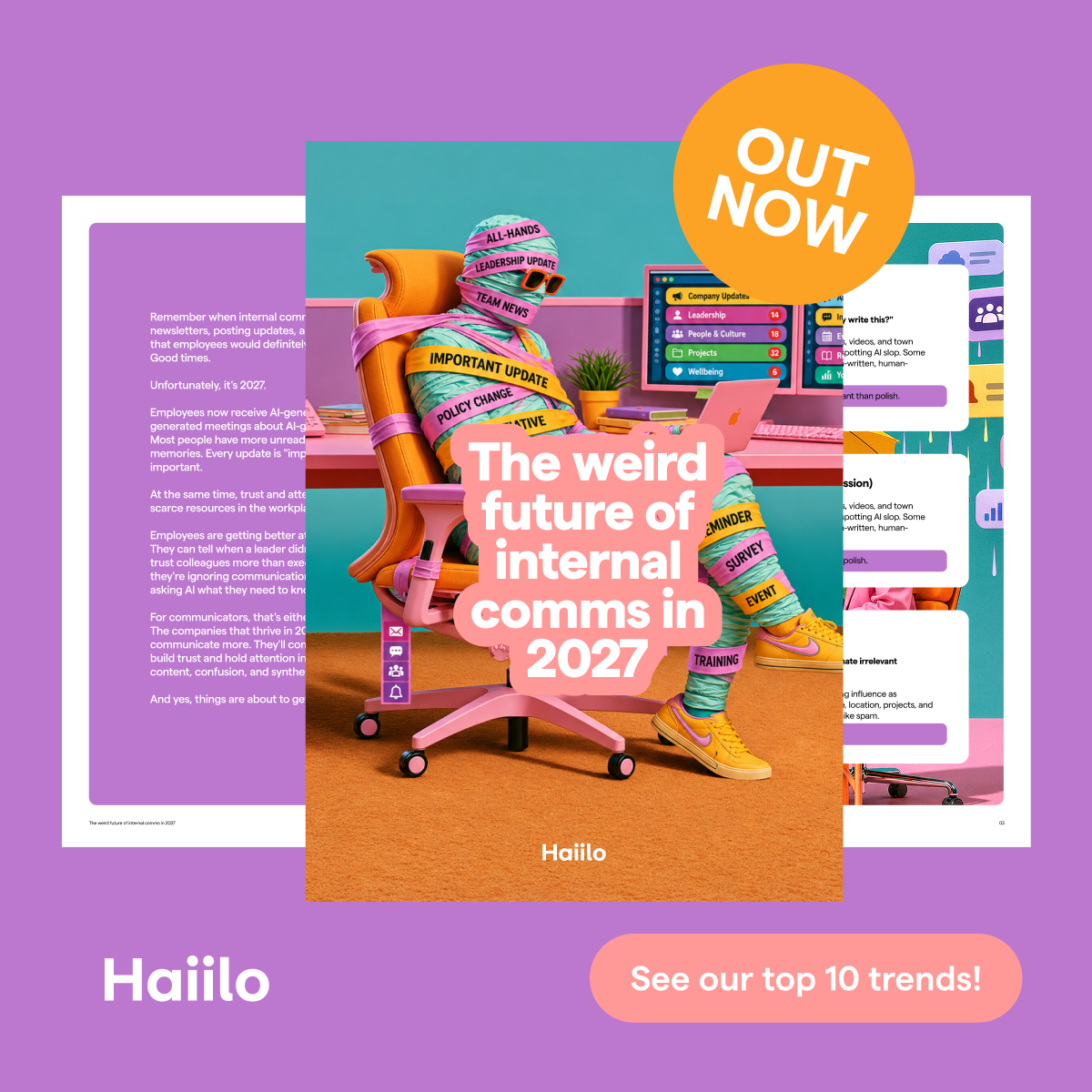
Internal comms will get weird in 2027
Find
your
flow
Bring communication, knowledge, and tools into one calm place — and help your people find their flow.