
What Should Communicators Use AI For? Everything.



The communications profession has often lagged in adopting new digital technologies that profoundly impact communication practices. Email, the internet, the web, social media, mobile technology, and live streaming quickly integrated into marketing and advertising, while organisational communicators largely ignored them. Many teams relied on established channels and familiar workflows long after employee expectations had shifted. Only when these technologies became impossible to ignore did the profession recognise the need to catch up to remain relevant, trusted, and effective.Generative Artificial Intelligence (GenAI) is the latest technology confronting communicators, and it is poised to be the most significant so far. Unlike earlier shifts, it does not just introduce a new channel or format, but changes how communication work is planned, created, and scaled. As with previous technologies, some communicators are experimenting with GenAI, mainly for writing and editing tasks. However, as an AI communication technology, its value extends well beyond copy generation. For now, the profession largely remains at the starting gate, uncertain how to move from cautious trials to meaningful, everyday use.
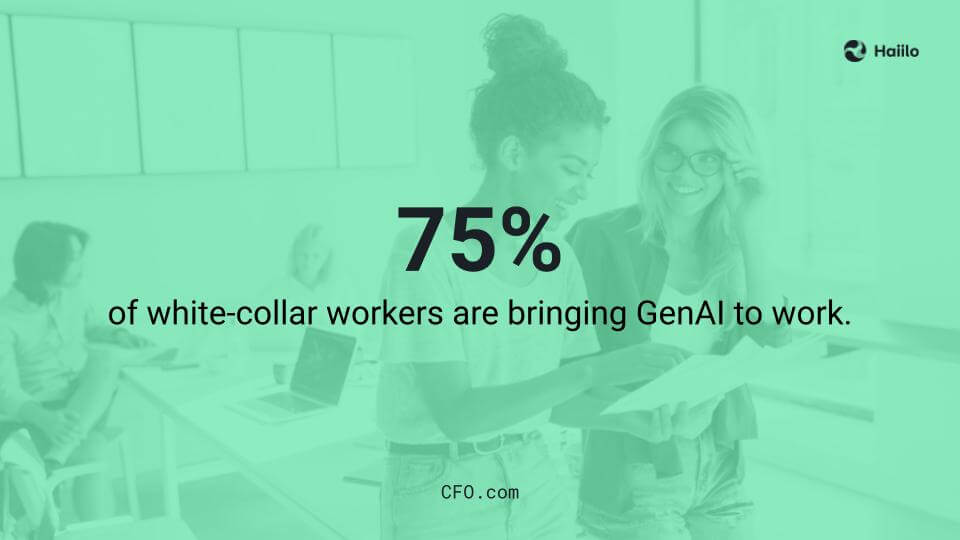
Fortunately, GenAI has an overarching characteristic that makes its adoption far easier than its predecessors: it requires no internal infrastructure. There is no need for servers, costly software subscriptions, investments in first-generation hardware, IT-heavy rollouts, or bespoke app development. For communication teams that already operate with limited technical support, this dramatically lowers the barrier to entry.GenAI is neither a platform nor a distribution channel or device. Instead, it functions as an enabling layer that can sit on top of existing tools and workflows. This makes it fundamentally different from earlier shifts that demanded long implementation cycles and organisational buy-in before any value was realised. As an AI communication technology, GenAI can be tested, learned, and applied incrementally, allowing communicators to build confidence and capability without waiting for large-scale transformation projects.GenAI is a personal assistant.In practice, many knowledge workers already treat GenAI this way. A recent study found that a significant share of white-collar employees are already bringing GenAI tools into their daily work, often on personal devices and without formal approval. This quiet adoption reflects both demand and frustration: people see immediate value, but lack clear guidance. With several powerful GenAI tools available for free, and paid versions typically costing around $20 per month, access is rarely the barrier.As an AI communication technology, this matters for communicators. When tools like ChatGPT, Google Gemini, Anthropic’s Claude, Perplexity, or Midjourney act as on-demand assistants, they support thinking, drafting, summarising, and sense-checking work in real time. The challenge is not availability, but helping teams use these tools responsibly, consistently, and in ways that genuinely improve communication quality.🤔 Is It Ok to Use AI Avatars in Employee Communication?
Haiilo’s Ava can help you generate content 10x faster.
Book a demoMost communicators struggle with how to use GenAIbeyond its role as a writing aid. Drafting emails and posts is often the first step, but it is rarely where the real value lies. The harder question is how GenAI can support thinking, planning, and decision-making without diluting expertise or judgement.Wharton Professor Ethan Mollick, author of Co-Intelligence, a New York Times bestseller on GenAI, suggests inviting GenAI to the table and using it for everything. His point is not blind automation, but partnership. Whatever task you are working on, test how GenAI might challenge assumptions, surface gaps, or improve outcomes before work is finalised.Are you about to interview an executive about an organisational change? Share your questions with GenAI and ask what is missing. Are you crafting a communication strategy to align employees with that change? Share the draft and ask where it could fail or confuse. Once the strategy is set, GenAI can help tailor messages for different employee cohorts, roles, or regions. When feedback starts coming in, this AI communication technology can also help identify patterns and themes faster than manual analysis.
💡Looking for Inspiration?: Best AI Prompts for Internal Communications [40+ Ideas]
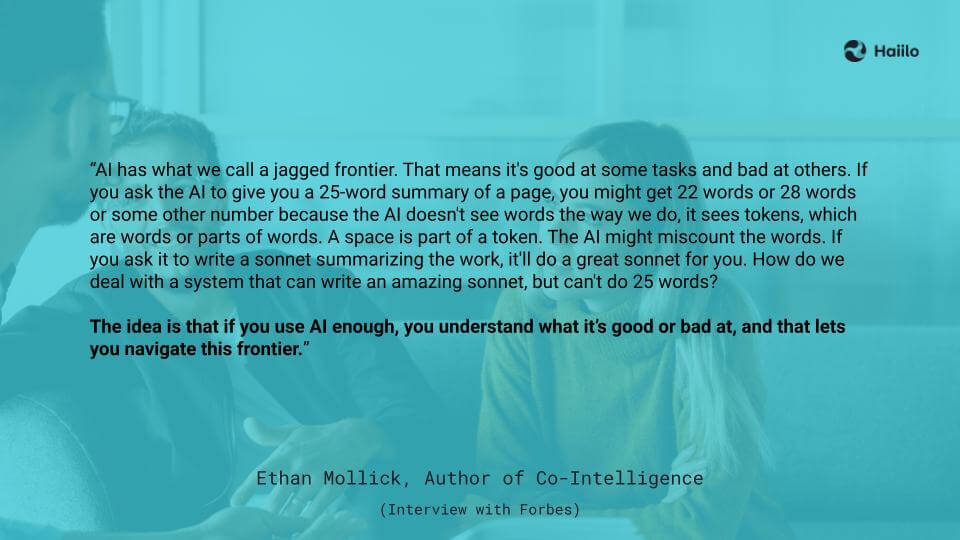
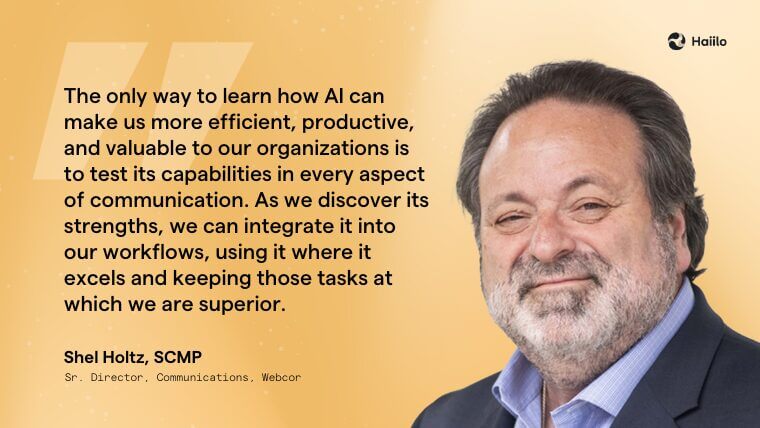
The only way to learn how AI can make us more efficient, productive, and valuable to our organisations is to test its capabilities across every stage of communication work. That means using it not just at the end of the process, but during planning, review, and evaluation. As we identify where it adds the most value, we can integrate it into daily workflows, relying on it for speed and scale while retaining human judgement for context, ethics, and nuance.Mollick outlines four rules for using GenAI that fit internal communications particularly well. One rule we have already explored is experiment often. Another is being the human in the loop, which aligns naturally with the communicator’s role as steward of clarity, trust, and tone. This balance is critical when applying AI communication technology in environments where accuracy and credibility matter.The rule that helped me most was to treat it like a person and tell it who it is. While there is no shortage of prompt frameworks and templates, the most effective prompts mirror how you would brief a subject-matter expert. The difference is simply that you start by clearly defining the role GenAI should play, setting expectations before asking it to contribute.
“You are a sustainability subject matter expert who specializes in zero-waste initiatives.” The responses you receive when seeking information about achieving zero waste will be far better. But don’t settle for the first answer you get. Correct it as you would a person. Ask for clarification. Ask follow-up questions. It’s a conversation, not an input-output exercise.
Mollick’s final rule is that the GenAI you are using today is the worst you will ever use. Capabilities will continue to improve, expand, and become more embedded in everyday tools. That makes staying current important, but not burdensome. Keeping an eye on developments can be lightweight and selective, focusing on practical use cases rather than every technical breakthrough.There are numerous newsletters (here’s a useful starting point: https://approachableai.com/top-ai-newsletters/) and podcasts (here’s a list to explore: https://geekflare.com/ai-podcasts/). I also recommend No Brainer from Geoff Livingston and Greg Verdino, who focus less on hype and more on how emerging tools actually change day-to-day work.If we follow these guidelines, perhaps the communication profession can assume a leadership role rather than once again lagging behind the rest of the business world. Used thoughtfully, AI communication technology gives communicators an opportunity to shape how AI is applied responsibly, clearly, and in service of better work.📚 Continue Reading: Trust But Verify: Navigating the Age of AI
About the Author
Shel Holtz is senior director of Communications at Webcor, a commercial general contractor and builder. He has worked in organizational communications for more than 45 years, leading communications at two Fortune 400 companies and working in the communication practices at two global HR consulting firms. He later launched his own consulting practice, advising some of the world’s largest organizations for more than 20 years before joining Webcor in 2017.Shel is a longtime blogger and a pioneer podcaster, starting the For Immediate Release podcast aimed at organizational communicators in January 2005. He is the author of six communication-themed books, along with countless articles in journals and magazines, and chapters in communication-focused titles such as Bob Dillenschneider’s The Public Relations Handbook. A frequent speaker on communication and technology, Shel is known for his practical perspective on how emerging tools—including AI communication technology—reshape internal communication work. He is a Fellow of the International Association of Business Communicators, a senior fellow of the Conference Board’s Marketing and Communication Council, a founding research fellow of the Team Flow Institute, and currently serves on the board of the Global Communication Certification Council.
Frequently asked questions about AI communication technology
What does AI communication technology actually mean for internal communicators?
AI communication technology refers to how generative AI supports the day-to-day work of communicators, not just content creation. It can help with planning messages, testing tone, summarising feedback, personalising communications for different audiences, and spotting gaps or risks before messages go live. Used well, it acts as a thinking partner that improves speed and quality without replacing human judgement.Is AI communication technology only useful for writing?
No. Writing is often the entry point, but it is also the most limited use. Communicators get more value when AI is used earlier and later in the workflow. For example, it can help stress-test a change narrative, analyse employee sentiment, or adapt messages across channels. When paired with a structured environment like an employee communications platform, AI supports consistency and clarity at scale.How can teams use AI communication technology without creating risk?
The key is guidance, not prohibition. Many employees already use AI informally, so communicators should lead by setting clear principles around data use, tone, and review. Keeping humans in the loop, validating outputs, and using AI inside trusted systems helps reduce risk. A secure social intranet also provides a controlled space to share updates and feedback shaped with AI support.How should communicators start using AI communication technology today?
Start small and experiment often. Pick real tasks—interview prep, message testing, feedback analysis—and see where AI adds value. Treat it like a colleague: give it context, explain the role you want it to play, and review the results critically. Over time, these experiments build confidence and help teams integrate AI into everyday communication work in a practical, responsible way.
Find
your
flow
Bring communication, knowledge, and tools into one calm place — and help your people find their flow.