
Context switching is the productivity tax nobody budgets for



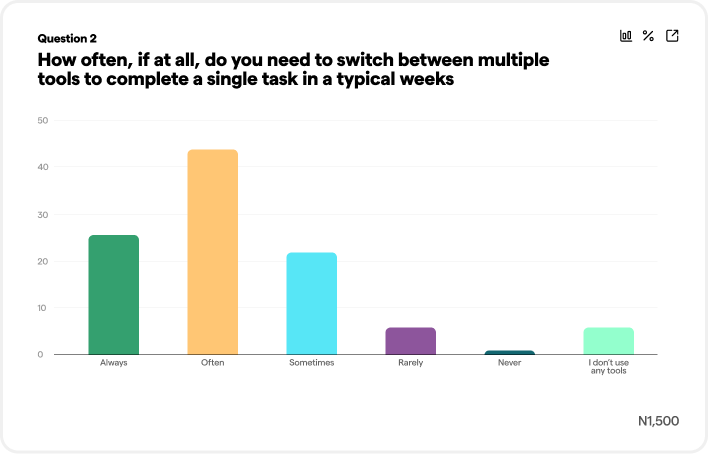
Two thirds of employees often need multiple tools to complete a single task. The cost is not switching. It is refocusing.
That’s the part most people underestimate.
Switching feels quick – harmless, even. A tab here, a message there, a quick check “before getting back to it.”
But what follows every switch is not instant. It’s a slow, invisible process of rebuilding focus. And that’s where productivity really gets lost.
The real impact of context switching at work
Let’s start with what the data from the latest State of the Employee Experience Report tells us.
- 67.5% of employees regularly need multiple tools to complete a single task
- Most report it takes several minutes to refocus after each switch
- Many say it takes 6 to 10 minutes or more to get fully back into flow (some studies say up to 23 minutes)
.png)
💡Read: The State of the Employee Experience 2026
This is where things get interesting. Because the cost of context switching is not the switch itself, it’s the reset that follows.
Every time you switch, your brain has to:
- remember what you were doing
- reload context
- reconstruct your line of thinking
Until that’s complete, you’re not really working at full capacity.
Attention is finite. Context switching spends it fast.
We talk about productivity like it’s a time problem. Instead, it’s an attention problem.
Our data highlights something most organizations ignore: cognitive load.
- People can only hold around 4 pieces of information at once
- Exceed that, and understanding drops
- Decisions slow down
- Errors increase
Now layer in context switching.
Each time you jump tools, you’re forcing your brain to:
- drop one mental model
- load another
- and then switch back again later
It’s like constantly restarting your laptop mid-task and wondering why nothing finishes properly. No wonder people feel busy but ineffective.
The hidden multiplier: refocus time
If, according to the data, it takes 6–10 minutes to refocus, and you switch only a few times per task, costs can escalate very quickly.
Multiply that interruption by:
- multiple tasks per day
- multiple days per week
- your entire workforce
All of a sudden, you’re no longer dealing with “a bit of switching.” You’re dealing with systemic productivity loss baked into every workday.
Fine, no single moment feels like a problem. But together, they reshape how work gets done. Or rather… how gets done slowly.
Why context switching has become the default
Most organizations didn’t design for this environment. It emerged from good intentions, with more tools to collaborate, more channels to communicate, and more flexibility in how work happens.
But over time, that “flexibility” has turned into fragmentation.
💡Read: How the digital workplace broke down
Our data paints a clear picture of the modern workday – one we all recognize:
- Conversations spread across multiple tools
- Documents stored in different locations
- Context living somewhere else entirely
In other words, switching is the workflow.
The real culprits behind excessive switching
As we’ve already covered, context switching happens because the system demands it. And there are three common causes.
1. Scattered conversations
One update in chat. Another in email. A comment in a document. A decision in a meeting you missed.
Now you’re piecing together what actually happened. This isn’t collaboration. It’s reconstruction.
2. Unclear ownership
Where should this live?
- The shared drive?
- The project tool?
- Someone’s inbox?
If the answer isn’t obvious, people hedge their bets. They check everywhere, which means more switching and less confidence.
3. Too many channels, not enough clarity
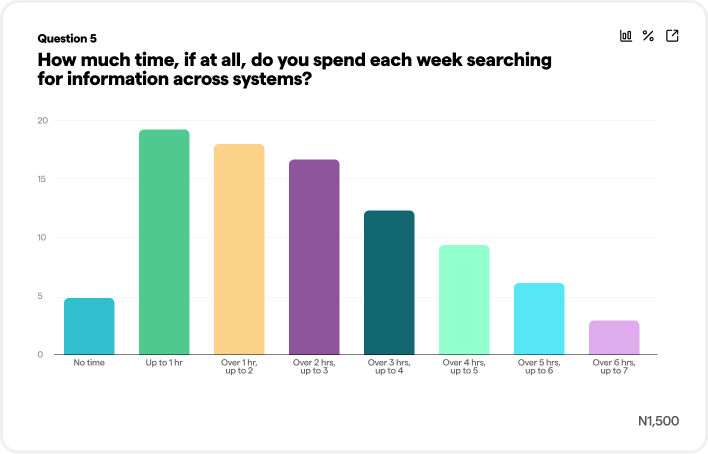
Our data highlights a common pattern: Employees are “somewhat confident” information reaches the right people.
That word “somewhat” matters.
It means:
- people don’t fully trust the system
- so they check more places
- and ask more questions
Which creates even more noise and more switching.
Why most fixes miss the point
When organizations try to solve this, they usually focus on tools. But our report makes one thing clear: The problem isn’t a lack of tools, it’s a lack of coherence.
Adding simply increases switching. Which increases cognitive load. Which slows everything down. This is additive bias in action. And it’s why well-intentioned improvements often make things worse.
Fixes that don’t require a full tech overhaul
You don’t need to rip everything out and start again.
Most of the biggest wins come from clarity, not capability.
1. Define a single source of truth
Pick one place for:
- updates
- decisions
- key information
Make it obvious. Make it consistent. Make it non-negotiable.
2. Reduce duplicate channels
Not everything needs its own space.
Every additional channel creates:
- another place to check
- another decision to make
- another opportunity to miss something
Fewer channels mean:
- less noise
- clearer signals
- fewer switches
3. Standardise where work happens by task type
This is simple, but powerful.
- Project updates in one place
- Documents in one place
- Decisions in one place
Not “wherever works.” Because “wherever works” usually means “everywhere at once.”
A quick self-audit (brace yourself)
Here’s a fun test:
Think back to your last working hour.
Ask yourself:
- How many times did I switch tools?
- Why did I switch?
- How long did it take to fully re-engage each time?
Now scale that across your day. Then your week. Then your team. That’s your hidden productivity tax.
The bigger picture: context switching is an experience problem
Like digital friction, this isn’t just about output. It’s about how work feels.
When switching is constant, focus becomes fragile, progress feels slow, and effort feels disproportionate.
Over time, frustration builds, engagement drops, and people question if it’s actually worth it. Even worse, they ask whether another employer can do a much better job.
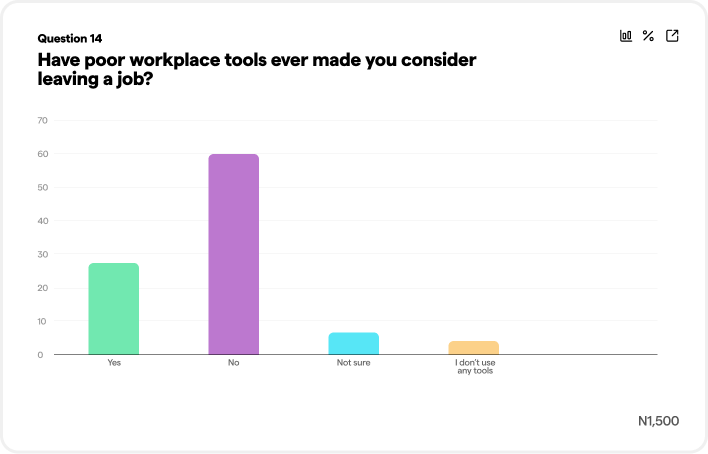
That’s why nearly a third of employees have considered leaving due to poor tools. Not because tools are broken. Because the experience of using them is.
Final thought: focus is the real ROI metric
For years, the question has been: “Do employees have the tools they need?” In 2026, that’s the wrong question.
The better question is:
“Can employees focus?”
Because focus is now:
- the scarcest resource
- the clearest indicator of productivity
- and the first thing digital friction destroys
Context switching isn’t just a workflow issue. It’s a signal that the system isn’t working as one.
Get the full picture
This is just one slice of the overall picture.
The full story, including where switching, searching, and fragmentation impact performance the most, is in our latest report.
Get the Haiilo State of the Employee Experience 2026 report to:
- Benchmark your organization against UK and US data
- Understand how workplace technology is shaping productivity
- Identify where focus is being lost and how to reclaim it
Because once you see how much time is spent refocusing, you start designing work very differently.
Context switching FAQs
Context switching is the process of moving your attention from one task, tool, or activity to another. It happens throughout the workday, whether you're jumping between email, chat, documents, meetings, or business applications. The switch itself is usually quick. The real cost comes from the mental effort required to regain focus and continue where you left off.
Every switch forces your brain to reload information, rebuild context, and reconnect with your previous train of thought. This refocusing period can take several minutes, meaning small interruptions quickly add up. Over time, employees spend less time in focused work and more time recovering from distractions.
The most effective improvements often focus on clarity rather than technology. Establishing a single source of truth, reducing duplicate communication channels, and standardizing where specific types of work happen can significantly reduce unnecessary switching and help employees stay focused longer.
Context switching is more than a productivity issue. It affects employee experience, engagement, and job satisfaction. When employees constantly struggle to find information or rebuild focus, work feels harder than it should. Reducing digital friction helps people work more effectively while improving their overall experience at work.

State of the Employee Experience 2026
Read the research in full
Find
your
flow
Bring communication, knowledge, and tools into one calm place — and help your people find their flow.