
From SEO to AEO: why brand visibility now depends on human signals
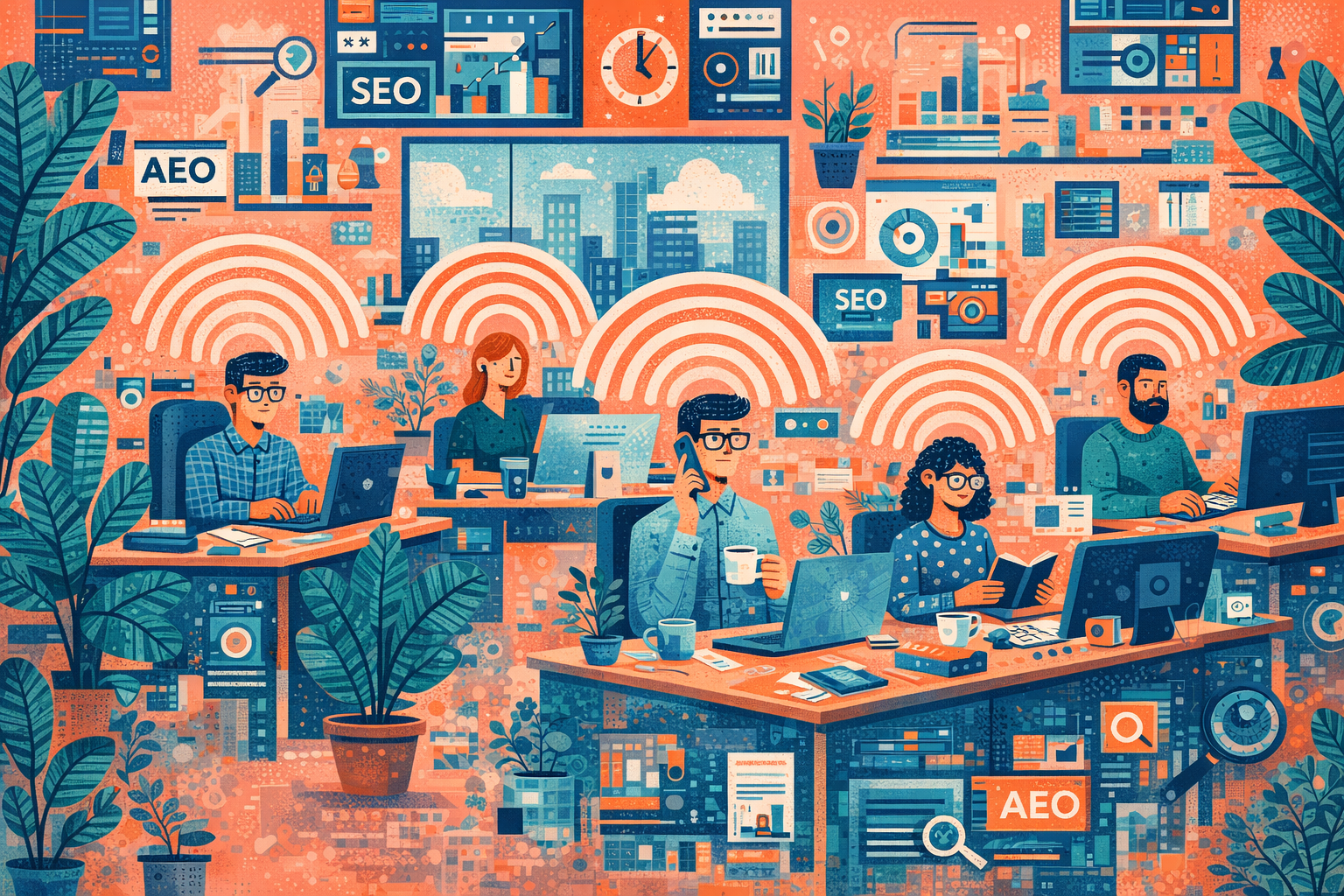


Search has changed. Not slowly. Not subtly. Fundamentally.
For years, digital visibility was about ranking pages. You optimized keywords, built backlinks, improved site speed, and aimed for position one.
Now, search engines don’t just rank pages, they generate answers.
Ask ChatGPT for the best intranet platforms. Ask Google’s AI Overview about digital workplace trends. Ask Perplexity to compare employee engagement tools.
You won’t get ten blue links. You’ll get a synthesized response. And that shift – from ranking pages to generating answers – changes the game completely.
This is AEO: Answer Engine Optimization. And here’s the uncomfortable truth for brands:
AEO isn’t just about your website anymore. It’s about your entire digital footprint. And your employees are an important part of that.
Read: Calm is a UX feature. Good workplace AI must protect it.
From ranking pages to generating answers
Traditional SEO was page-centric.
You created content. Search engines indexed it. Algorithms ranked it based on relevance and authority. Users clicked through.
AI answer engines work differently.
Large language models don’t just retrieve content. They synthesize across sources. They look at patterns. Associations. Mentions. Expertise signals. Sentiment. Context.
They generate a response based on the broader ecosystem of information available.
That means visibility is no longer tied to a single optimized page.
It’s tied to:
- How often your brand is mentioned
- In what context it’s mentioned
- Who is associated with it
- What expertise signals surround it
- How consistently your narrative shows up across the web
In other words, your digital reputation has become distributed. And distributed visibility depends on human signals.
Read: The 2026 guide to AI in internal comms
AI engines synthesize across ecosystems
Large language models (LLMs) are trained on masses of publicly available text. They ingest articles, blogs, forums, commentary, documentation, interviews, social posts, and more.
They don’t “rank” in the traditional sense. They detect patterns and associations.
If your brand repeatedly appears in conversations about:
- Employee experience
- Digital workplace transformation
- Internal communications strategy
- AI-powered intranets
That association strengthens.
If your competitors appear more often, in richer contexts, across more credible voices, that strengthens their association instead. AI answer engines build a mental model of the market. And that model is shaped by distributed signals.
Your website is one signal. Your employees on LinkedIn is another.
First-hand expertise carries weight
There’s another shift happening:
AI engines increasingly value first-hand expertise.
When people with identifiable roles, experience, and consistent topical focus publish content, that creates a strong signal.
A VP of Internal Comms writing about change management. A CIO sharing lessons from digital transformation. A Head of People discussing employee engagement metrics.
These aren’t anonymous blog posts. They’re attributed expertise. When that expertise consistently references a brand, a product, or a point of view, it reinforces association.
That’s powerful, because corporate websites speak in “brand voice”.
Employees speak in “human voice”.
And in an AI-first search world, human voice matters more than ever.
Corporate websites alone aren’t enough
For years, brands invested heavily in owned media. Blogs. Resource hubs. Landing pages.
Deep, structured, authoritative content like this is essential. But it’s no longer sufficient.
AI models don’t just look at what you say about yourself. They absorb what the ecosystem says about you.
That includes:
- LinkedIn posts
- Industry commentary
- Thought leadership from employees
- Panel discussions
- Guest articles
- Podcast transcripts
- Mentions in third-party publications
Your brand narrative is no longer centralized. It’s networked. And networks outperform silos.
Why distributed thought leadership strengthens brand association
Here’s where it gets interesting.
When multiple people inside an organization consistently publish thoughtful, relevant content around a shared theme, something powerful happens.
The brand becomes associated with that topic at a structural level.
For example:
If 10 employees regularly post about employee engagement strategy, internal communications measurement, and digital adoption – and consistently reference the same core ideas – AI systems begin to cluster those signals.
The brand and the topic become semantically linked. It’s not about one viral post. It’s about density. Repetition. Consistency. Authority distributed across multiple credible profiles.
That’s not traditional SEO. That’s ecosystem building.
The compounding effect of employee advocacy
This is where employee advocacy moves from “nice-to-have” to strategic infrastructure.
Unstructured employee posting is unpredictable. Some people post. Some don’t. Messaging drifts. Themes fragment. But structured advocacy changes that.
When organizations empower employees with relevant, high-quality content – and align around shared narratives – the signal becomes consistent. Consistency compounds.
Every post reinforces:
- Brand-topic association
- Visibility across networks
- Engagement signals
- Human credibility
- Distributed expertise
Over time, this increases your brand’s surface area in the AI training and inference ecosystem.
The more your organization shows up across credible human voices, the stronger the signal becomes.
Read: How marketing can retain credibility in a skeptical world
How LLM ecosystems actually “see” your brand
Let’s simplify how this works.
Large language models don’t think in keywords. They operate through relationships.
They detect:
- Entities (brands, people, products)
- Context (what those entities are discussed alongside)
- Sentiment (positive, negative, neutral framing)
- Authority signals (depth, expertise, consistency)
If your brand only exists on your website, the signal is narrow.
If your brand is referenced in:
- Employee thought leadership
- Industry commentary
- Customer stories
- Social discussions
- Partner mentions
The signal is broader. And when that broader signal consistently aligns with specific topics, the association strengthens.
That’s AEO.
Answer Engine Optimization isn’t about tricking an algorithm. It’s about strengthening the web of associations around your brand. And humans are the strongest connectors in that web.
Why this matters now
The buying journey is shifting.
Prospects aren’t just searching “best employee experience platform” and browsing websites.
They’re asking AI tools:
- “What are the top intranet platforms for frontline employees?”
- “Which tools integrate well with Microsoft 365?”
- “What’s the difference between X and Y?”
And the AI generates a response.
If your brand isn’t part of the broader conversation, it’s less likely to be synthesized into that answer.
You don’t control the answer. But you influence the ecosystem that shapes it. And the strongest influence isn’t another landing page. It’s credible human voice.
That’s why:
In an AI-first search world, your employees are ranking factors.
How Haiilo Advocacy supports AEO
At Haiilo, we know employee advocacy isn’t just about reach. It’s about structured, scalable signals.
Haiilo Advocacy helps organizations:
1. Create consistent narratives at scale
Provide employees with high-quality, relevant content aligned to strategic themes, ensuring distributed posts reinforce the same core messages.
2. Amplify human expertise
Empower subject matter experts across departments to share insights in their own voice, strengthening authority signals across networks.
3. Increase brand surface area
Expand your brand’s digital footprint beyond your website, into LinkedIn feeds, industry conversations, and professional communities.
4. Build semantic density
Through consistent, repeated association between your brand and your core topics, strengthen how AI ecosystems “understand” your position in the market.
5. Orchestrate distributed visibility
Turn employee advocacy from ad-hoc posting into a coordinated engine that compounds over time.
Why Haiilo Advocacy?
If visibility now depends on distributed human signals, you need more than occasional employee posts. You need consistency. Haiilo Advocacy helps you make that easy, without adding more work or spend for Marketing.
With Haiilo Advocacy, you can:
- Turn employee trust into steady reach: Real voices to reinforce your key themes.
- Make sharing simple: Approved, on-brand content employees can share in one tap.
- Move faster with AI support: AVA helps draft and adapt posts in seconds.
- See what’s actually working: Clear reporting on reach, traffic, and impact.
- Scale without chaos: Built-in governance keeps everything aligned and safe.
If you’re rethinking how your brand shows up in an AI-first world, it might be time to rethink employee advocacy with Haiilo.
FAQ: answer engine optimization and employee advocacy
AEO is the shift from optimizing pages for rankings to optimizing your brand for inclusion in AI-generated answers. Instead of trying to win position one, you’re trying to become part of the answer itself. That means strengthening how your brand shows up across the wider digital ecosystem, not just your website.
SEO focuses on keywords, backlinks, and page performance. AEO focuses on relationships, context, and credibility. AI engines don’t just retrieve content, they synthesize it. So they look at who talks about you, how often, in what context, and whether those signals feel trustworthy and consistent.
Because AI models value human expertise. When real people consistently share informed, relevant perspectives, it creates stronger signals than brand-only content. Employees add depth, credibility, and frequency to your presence, all of which influence how AI systems associate your brand with key topics.
Short answer: no. Your website is still essential, but it’s just one signal. AI engines also absorb LinkedIn posts, articles, interviews, and discussion threads. If your brand only shows up in owned content, your visibility is limited. If it shows up everywhere, your chances of being included in answers increase.
Start by aligning your narrative, then scale it through people.
- Define your core topics clearly
- Enable employees to share relevant, useful content
- Focus on consistency over one-off posts
- Track which themes and voices drive engagement
AEO isn’t about gaming the system. It’s about showing up, consistently, in the conversations that matter.
Find
your
flow
Bring communication, knowledge, and tools into one calm place — and help your people find their flow.